Southern Sea Otter
Enhydra lutris
Learn More About Sea Otters
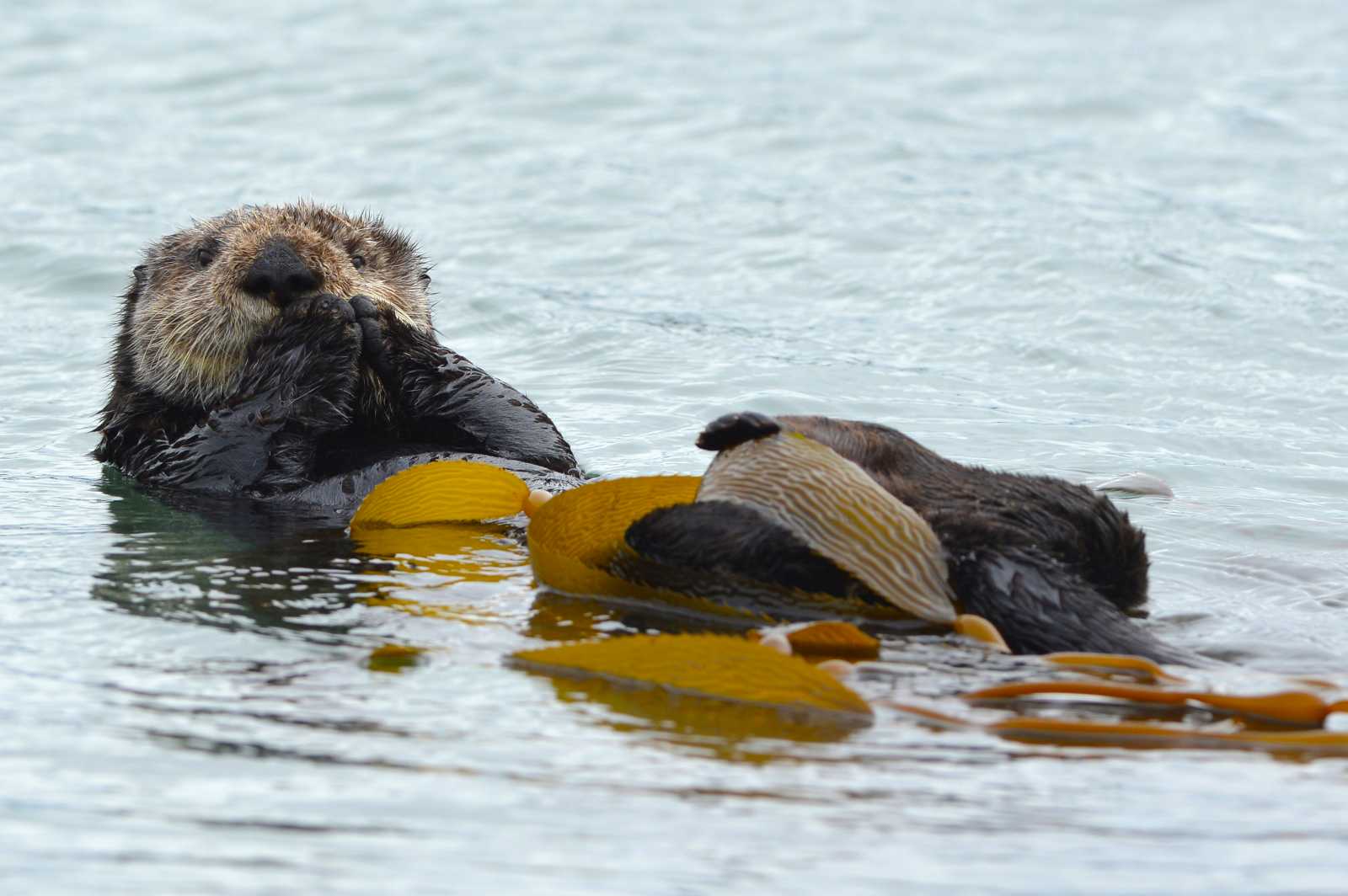
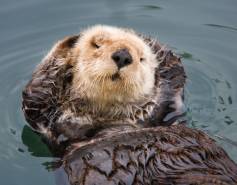
As members of the weasel or mustelid family, southern sea otters are the smallest marine mammal. Like other members of this family, they have very thick fur. In fact, at 850,000 to 1 million hairs per square inch, sea otters have the thickest fur of any mammal.
Their fur actually consists of two layers, an undercoat and longer guard hairs. As marine mammals without any blubber to keep them warm, otters need this double-layer system that traps air next to their skin, preventing it from getting wet and protecting them from chilly ocean waters.
Sea otters are usually dark brown, often with lighter guard hairs. In California, adult female southern sea otters weigh 35 to 60 pounds. The males reach up to 90 pounds.
What do they sound like?
The greatest threats to marine mammals are caused by people, but we can also be their greatest champions.
Sign up for email from The Marine Mammal Center to stay updated on how you can be an advocate and champion for marine mammals like sea otters.


Meet Our Patients: Langly & Sprout
Southern sea otter pup Langly was orphaned when her mother received a fatal bite from a great white shark. Luckily, her mother was able to get Langly safely to shore where our trained responders were able to rescue her.
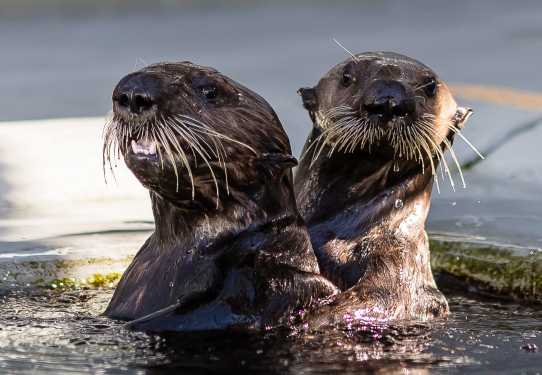
Sprout, a sea otter pup suffering from domoic acid toxicity, came to our hospital not long after Langly arrived. The two young otters formed a strong bond and spent much of their time swimming and playing together as they regained their health.
photo © The Marine Mammal Center / USFWS permit MA101713-1
Habitat & Population Status
Sea otters were once found from Mexico to Alaska, and even Japan. Currently, the California population of about 3,000 individuals range from Half Moon Bay to Point Conception. There is a much larger population of sea otters found in Alaska, and some are still found in Russia as well.
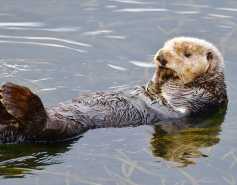
As a coastal species, sea otters prefer areas with kelp, which they use as an anchor by wrapping themselves in it when resting.
Sea otters were hunted extensively in the past for their luxurious fur, leading to a dramatic decline in their population and a need for protection. Listed as a threatened species, southern sea otters are still vulnerable, especially to the risk of oil spills.
Without blubber to protect them from chilly ocean waters, sea otters rely on their thick fur, but if exposed to oil their fur loses its insulating qualities. Sea otters can be further harmed by oil’s fumes or by eating contaminated food. Other threats include disease, parasites, boat strikes, predation and entanglement.
Sea Otter Research at The Marine Mammal Center
{"image":"\/Animals\/Wild\/Sea otter\/cropped-images\/sea-otter-face-shutterstock-423-0-3176-2481-1602701548.jpg","alt":"southern sea otter","title":"Clinical Signs and Pathology Associated With Domoic Acid Toxicosis in Southern Sea Otters","link_url":"https:\/\/www.marinemammalcenter.org\/publications\/clinical-signs-and-pathology-associated-with-domoic-acid-toxicosis-in-southern-sea-otters","label":"Research Paper","type":"publication"}
Clinical Signs and Pathology Associated With Domoic Acid Toxicosis in Southern Sea Otters
Read More{"image":"\/Animals\/Wild\/Sea otter\/cropped-images\/sea-otter-grooming-head-shutterstock-22-86-3617-2826-1616709449.jpg","alt":"sea otter grooming","title":"Parasitic Skin Disease in Threatened Southern Sea Otters","link_url":"https:\/\/www.marinemammalcenter.org\/publications\/parasitic-skin-disease-in-threatened-southern-sea-otters","label":"Research Paper","type":"publication"}
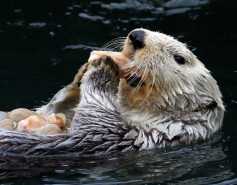
{"image":"\/Animals\/Wild\/Sea otter\/sea-otter-shutterstock.jpg","alt":"sea otter eating shellfish","title":"Parasite-Associated Hepatitis in Southern Sea Otters","link_url":"https:\/\/www.marinemammalcenter.org\/publications\/parasite-associated-hepatitis-in-southern-sea-otters","label":"Research Paper","type":"publication"}
{"image":"\/Animals\/Wild\/Sea otter\/sea-otter-photo-c-brian-simuro.jpeg","alt":"sea otter in a seagrass bed","title":"New Brucella Bacterial Infection in Southern Sea Otters","link_url":"https:\/\/www.marinemammalcenter.org\/publications\/new-brucella-bacterial-infection-in-southern-sea-otters","label":"Research Paper","type":"publication"}
Breeding & Behavior
At about 4 or 5 years old, female sea otters typically have their first pup after a four-to-five-month-long pregnancy. Females can give birth any time of the year, but most in California have their pup between January and March.
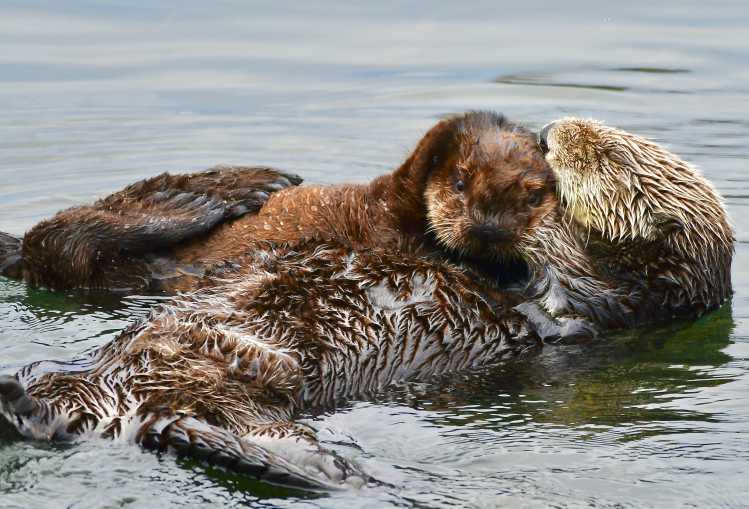
Newborn sea otters weigh 3 to 5 pounds. A sea otter pup’s fur traps so much air that they cannot dive underwater. When a mother leaves to go hunt for food, she will wrap her baby in kelp, leaving it to bob on the surface of the ocean like a cork. Mothers spend much of their time grooming their pups and are often observed carrying them on their chest.
Sea otter pups begin to learn to swim at around 4 weeks old. After about eight months staying alongside their mothers, pups are weaned and on their own.
Sea otters are a social species—females and their pups are often observed spending time together in one group and males in another.
As one of the few animals that uses tools, sea otters feed on shelled creatures like clams and abalone, using a rock to break them open. When sea otters are underwater foraging for food, they make use of the loose skin under their armpits, using the area like pockets to store food as they continue their search.
Sea otters can eat 25 to 30 percent of their body weight in one day, which would be equivalent to a 175-pound human eating 45 pounds of food in one day.


