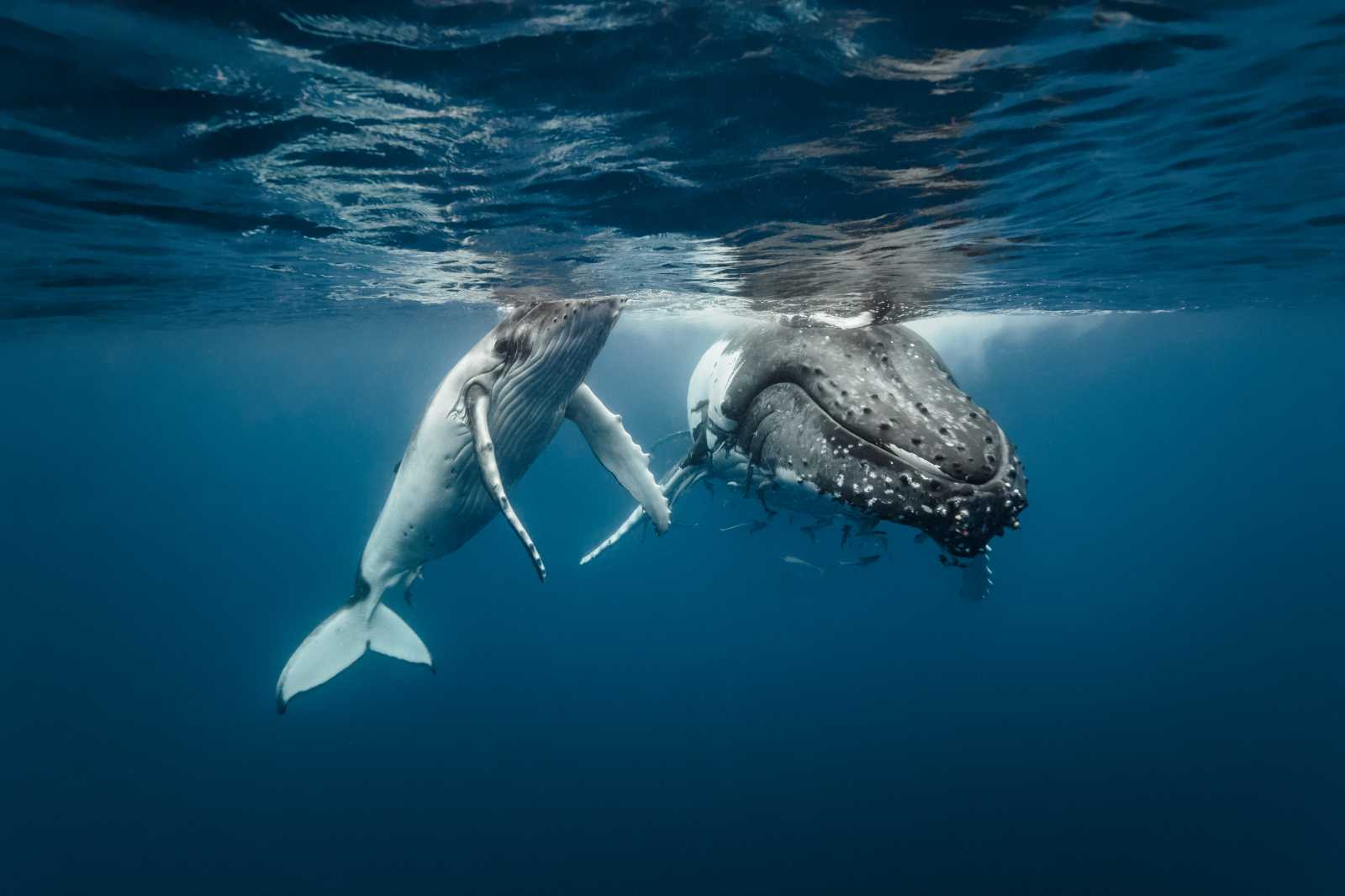
Whales, Dolphins and Porpoises
Learn More About Cetaceans
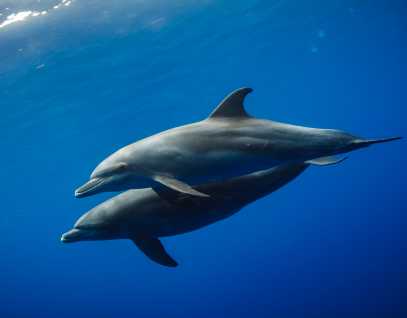
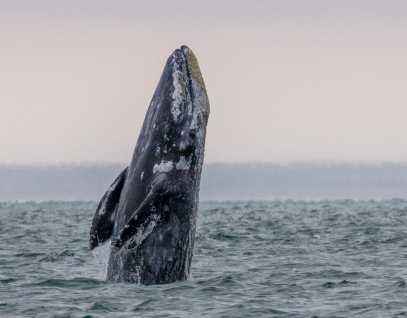
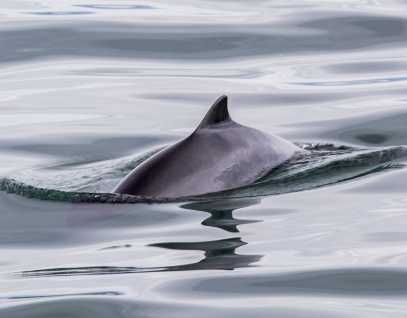
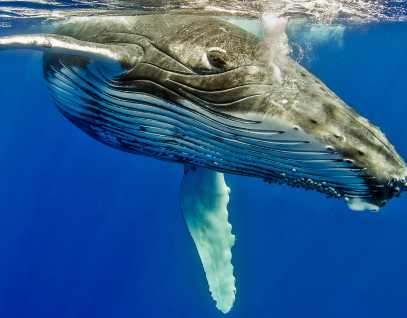
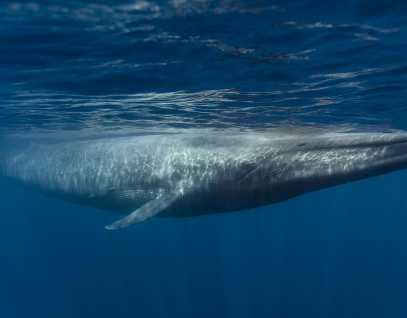
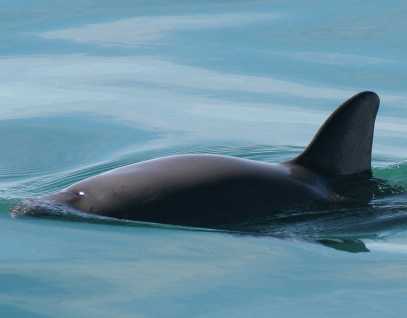
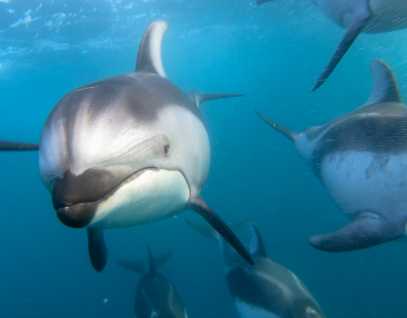
Marine mammals in the cetacean family include whales, dolphins and porpoises. These animals are completely aquatic, meaning they spend all of their time in the ocean and cannot survive on land.
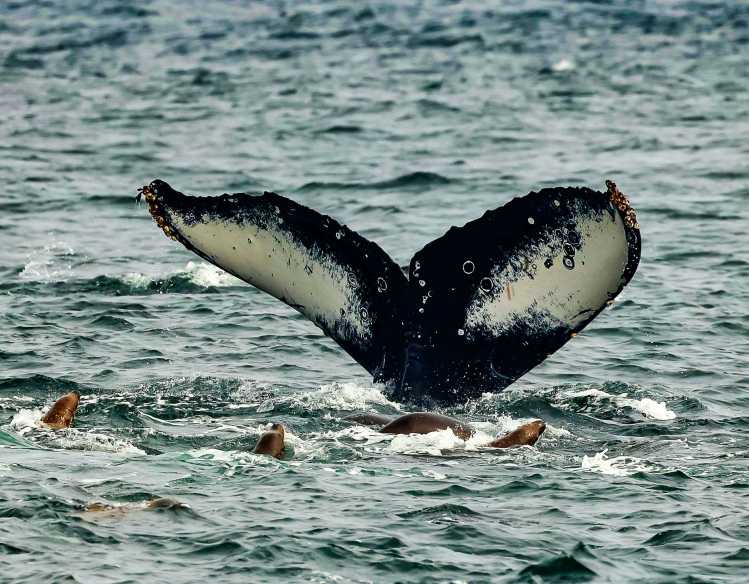
Whales, dolphins and porpoises have two front flippers, and their tails are uniquely shaped into two horizontal extensions, called flukes, that provide tremendous swimming power.
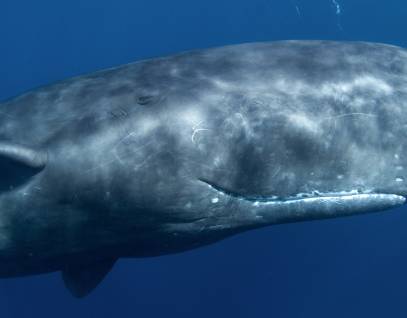


Evolution and Adaptations
Millions of years ago, the ancestors of whales lived on land. Scientists believe these land ancestors looked like small dogs, but were probably more closely related to hippos and went into the ocean about 60 million years ago.
Over time, these ancestors adapted to survive solely in the ocean environment. Their front legs turned into paddle-shaped flippers, they lost their back legs, their tails grew larger and widened to form flukes, and they developed a thick layer of fat, called blubber, to keep warm in the ocean. Also, their skulls elongated and the nostrils shifted to the top of their heads (blowholes) to aid in breathing at the ocean's surface.
They developed a series of adaptations related to diving, which include the ability to store more oxygen in their blood and muscles and having more blood volume relative to their body size than land mammals.
Cetacean Conservation at The Marine Mammal Center
{"image":"\/Animals\/Wild\/Humpback whale\/cropped-images\/humpback-by-bill-keener-c-the-marine-mammal-center-noaa-permit-21678-0-0-4602-3594-1625873241.jpg","alt":"","label":"Cetacean Conservation","title":"Field Research","link_url":"\/science-conservation\/conservation\/cetacean-conservation\/field-research","type":"page"}
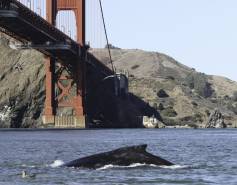
{"image":"\/Animals\/Patients\/Rescues\/cropped-images\/entangled-humpback-photo-c-noaa-mmhsrp-permit-18786-04-102-0-1177-919-1604010197.jpg","alt":"","label":"Cetacean Conservation","title":"Entanglement Response","link_url":"\/science-conservation\/conservation\/cetacean-conservation\/entanglement-response","type":"page"}
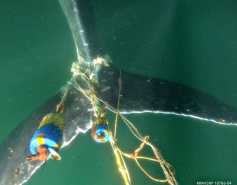
{"image":"\/Animals\/Wild\/Gray whale\/cropped-images\/gray-whale-angel-island-by-cara-field-c-the-marine-mammal-center-100-15-1916-1496-1610383444.jpg","alt":"","label":"Cetacean Conservation","title":"Stranding & Necropsy","link_url":"\/science-conservation\/conservation\/cetacean-conservation\/stranding-necropsy","type":"page"}
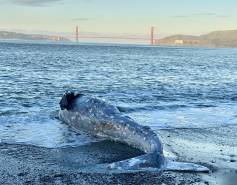
Population Status
Many whales are endangered, largely due to past hunting. Years ago, people used the oil from the blubber of whales for all sorts of items, including oil burned in lamps and ingredients for manufacturing lipstick. They also used whale meat to eat or make pet food, sinews for tennis racquet strings and baleen as supports in women’s underwear. A waxy substance called ambergris, which is from a sperm whale's digestive system, was used in making perfume. Ambergris was very valuable, and a large lump found by a beachgoer was worth a fortune.
Since 1986, there has been a ban or moratorium on hunting the large whales for commercial uses. However, some countries still kill whales for scientific purposes, and others have illegally resumed commercial whaling. This is controversial because the products from these whales are still used commercially. Many scientists question whether the whales really need to be killed to learn the sorts of things being studied. Certain Native American tribes are still allowed to hunt whales for subsistence. These hunts are regulated with specific rules for the method of hunting and yearly quotas that limit the number of whales taken.
Many people are concerned about the fate of the small whales (dolphins and porpoises). Thousands die every year from getting caught in fishing nets and plastic trash. Toxins and pollution in the ocean are affecting the health of these animals and likely their ability to fight off diseases.
Around the world, there has been an increase in reported strandings of marine mammals. Other species are suffering due to loss of their habitat. Sometimes even whale watching can interfere with and harass whales, if the boats venture too close to the whales or separate mothers from calves. Small whales are sometimes captured for display in aquaria and even hotels, and many people question the quality of life and health for these animals. Other species of small whales are still sometimes hunted and eaten in some parts of the world.
In the recent past, popular movements helped to save the whales from hunting. Unfortunately, the whales are not completely safe. We need to understand and solve some of the problems currently threatening whales like climate change, boat strikes, entanglement in nets and noise pollution.
Cetacean Research at The Marine Mammal Center
{"image":"\/Animals\/Wild\/Other species\/beaked-whale-shutterstock.jpg","alt":"beaked whale","title":"Advances in Research on the Impacts of Anti-Submarine Sonar on Beaked Whales","link_url":"https:\/\/www.marinemammalcenter.org\/publications\/advances-in-research-on-the-impacts-of-anti-submarine-sonar-on-beaked-whales","label":"Research Paper","type":"publication"}
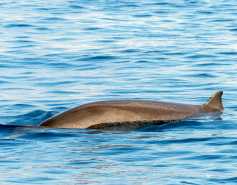
Advances in Research on the Impacts of Anti-Submarine Sonar on Beaked Whales
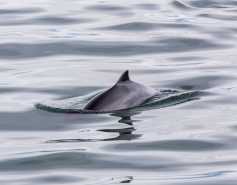
Read More{"image":"\/Animals\/Wild\/Harbor porpoise\/harbor-porpoise-shutterstock-2.jpg","alt":"harbor porpoise","title":"Harbor Porpoises Catching and Handling Large Fish","link_url":"https:\/\/www.marinemammalcenter.org\/publications\/harbor-porpoises-catching-and-handling-large-fish","label":"Research Paper","type":"publication"}
{"image":"\/Animals\/Wild\/Other species\/Vaquita-Olson-NOAA.jpg","alt":"vaquita","title":"Protecting Critically Endangered Vaquita from Entanglement Through Field Capture","link_url":"https:\/\/www.marinemammalcenter.org\/publications\/protecting-critically-endangered-vaquita-from-entanglement-through-field-capture","label":"Research Paper","type":"publication"}
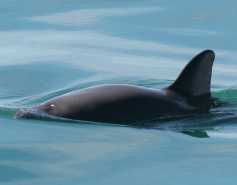
Protecting Critically Endangered Vaquita from Entanglement Through Field Capture
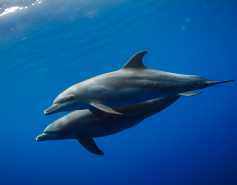
Read More{"image":"\/Animals\/Wild\/Other species\/dolphin-shutterstock.jpg","alt":"Two dolphins","title":"Brain Parasites in South African Dolphins","link_url":"https:\/\/www.marinemammalcenter.org\/publications\/brain-parasites-in-south-african-dolphins","label":"Research Paper","type":"publication"}
Name a Whale
Searching for a unique and memorable gift? Go whaley big for your loved one when you give the gift of naming a whale in their honor. Perfect for any occasion, this gift is one to be cherished because it helps protect whales and their ocean home.