Northern Elephant Seal
Mirounga angustirostris
Learn More About Northern Elephant Seals
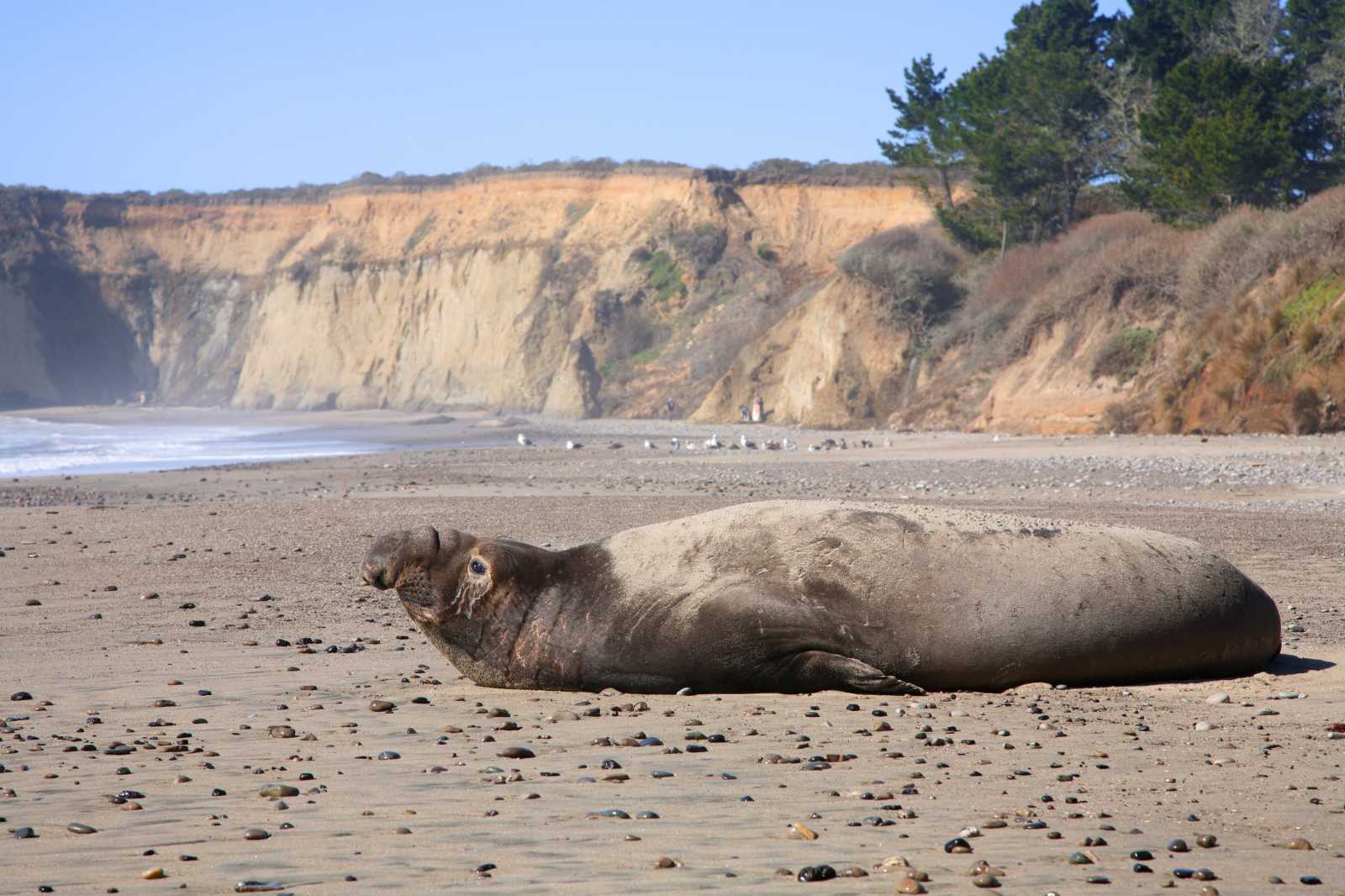
Elephant seals got their name because adult males have large noses that resemble an elephant's trunk. Males begin developing this enlarged nose, or proboscis, at sexual maturity, which is at about three to five years old. Their proboscis is fully developed once the seal reaches around 7 to 9 years old
Adult males may grow to over 13 feet in length and weigh up to 4,500 pounds. The females are much smaller at 10 feet in length and 1,300 pounds.
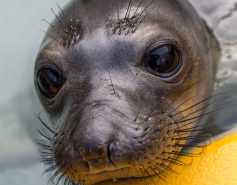
The northern elephant seal is the second largest seal in the world after the southern elephant seal. As part of the phocid, or true seal, family, elephant seals have ear holes and short front flippers that allow them to move on land by flopping on their bellies, also known as “galumphing.” Elephant seals also have a broad, round face with very large eyes.
What do they sound like?
Meet Our Patient: Bilbo
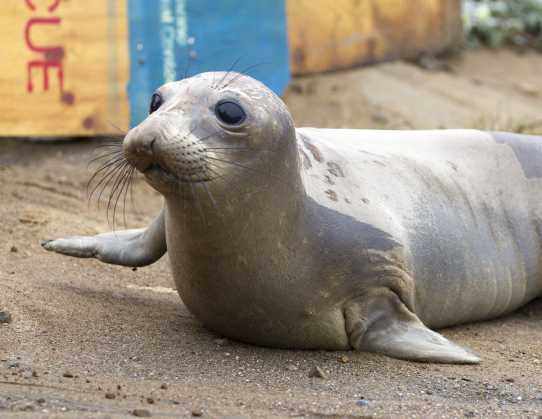
Elephant seal pup Bilbo was found on a beach in San Luis Obispo with major shark bite wounds and was brought to our hospital for much-needed medical care.
Once at the Center, veterinarians found that 9-month-old Bilbo had a fractured jaw and a fractured right front flipper, in addition to the wounds on his back, shoulder and neck. Veterinarians performed a partial flipper bone amputation on his fractured front flipper to help it heal.
After over a month of care at the Center, Bilbo was released back to the wild at San Simeon, a known elephant seal breeding area, near many other elephant seals his age.
The greatest threats to marine mammals are caused by people, but we can also be their greatest champions.
Sign up for email from The Marine Mammal Center to stay updated on how you can be an advocate and champion for marine mammals like northern elephant seals.


Habitat & Population Status
Northern elephant seals are found in the North Pacific, ranging from Baja California, Mexico, to the Gulf of Alaska and Aleutian Islands. Their breeding grounds are offshore islands, such as the Channel Islands, Año Nuevo, Point Reyes and Piedras Blancas.
Males have been observed further north toward the Alaskan continental shelf while females feed in the open ocean.
Did you know that the northern elephant seal is a conservation success story? After whales became scarce, elephant seals were hunted to the brink of extinction primarily for their blubber, which people used for lamp oil. By 1910, it was estimated that there were fewer than 100 elephant seals, all found on Guadalupe Island off Baja California, Mexico.
Today, the northern elephant seal population has rebounded to approximately the size it was before hunting. It’s estimated that there are 150,000 individuals, with 124,000 in California waters.
Elephant Seal Research at The Marine Mammal Center
{"image":"\/Animals\/Patients\/Elephant seals\/es-photo-by-bill-hunnewell-c-the-marine-mammal-center-1.jpg","alt":"northern elephant seal","title":"Muscle-Wasting Disease in Elephant Seal Pups","link_url":"https:\/\/www.marinemammalcenter.org\/publications\/muscle-wasting-disease-in-elephant-seal-pups","label":"Research Paper","type":"publication"}
{"image":"\/Animals\/Patients\/Elephant seals\/2018\/es-seafoam-by-bill-hunnewell-c-the-marine-mammal-center-1.jpg","alt":"northern elephant seal with mouth open, showing teeth","title":"Treatment of Canine Tooth Fractures in the Northern Elephant Seal: Three Cases","link_url":"https:\/\/www.marinemammalcenter.org\/publications\/treatment-of-canine-tooth-fractures-in-the-northern-elephant-seal-three-cases","label":"Research Paper","type":"publication"}
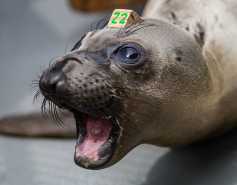
Treatment of Canine Tooth Fractures in the Northern Elephant Seal: Three Cases
Read More{"image":"\/Animals\/Patients\/Elephant seals\/cropped-images\/es-by-bill-hunnewell-c-the-marine-mammal-center-3-2-1214-3454-3512-1600891002.jpg","alt":"northern elephant seal","title":"Diagnostic Tests for Lungworm-Infected Northern Elephant Seals","link_url":"https:\/\/www.marinemammalcenter.org\/publications\/diagnostic-tests-for-lungworm-infected-northern-elephant-seals","label":"Research Paper","type":"publication"}
Breeding & Behavior
Northern elephant seals spend the vast majority of their time in the open ocean—up to 5,000 miles offshore—only coming to shore twice each year to breed and molt.
Each winter, elephant seals arrive at their breeding beaches, called rookeries, in Mexico and California. Males are the first to arrive and they fight each other to establish dominance, often developing calloused chests from these battles. During this time, dominant males will often inflate their noses and produce a noise that sounds like a drum to warn weaker males away.
Females soon arrive and associate with dominant males. Several days after coming onto the beaches, the females give birth to the pups they have been carrying since the previous year. Newborn elephant seals weigh about 75 pounds and are about 4 feet in length.
Newborn elephant seals have a black coat, which they molt, or shed, when they wean from their mothers at about 1 month old. Once they molt, a sleek, silver-gray coat is revealed. Within a year, the coat will turn a silvery brown.
During their first month of life, the pups nurse from their mothers and gain about 10 pounds a day. The mothers do not eat during this period and after about a month, they return to sea to feed. Meanwhile, the now-300-pound weaned pups, called "weaners," remain on rookery beaches.
For the next two months, the weaners venture into the water for short periods of time, teaching themselves to swim and find food. Eventually, they learn to feed on squid, fish and occasionally small sharks.
While in the open ocean, northern elephant seals spend a lot of time diving up to depths over 5,000 feet. These dives can last for up to two hours at a time, and the seals rarely spend more than four minutes at the surface between dives.
As opportunistic feeders, elephant seals are believed to feed on bottom-dwelling marine animals such as ratfish, swell sharks, spiny dogfish, eels, rockfish and squid.
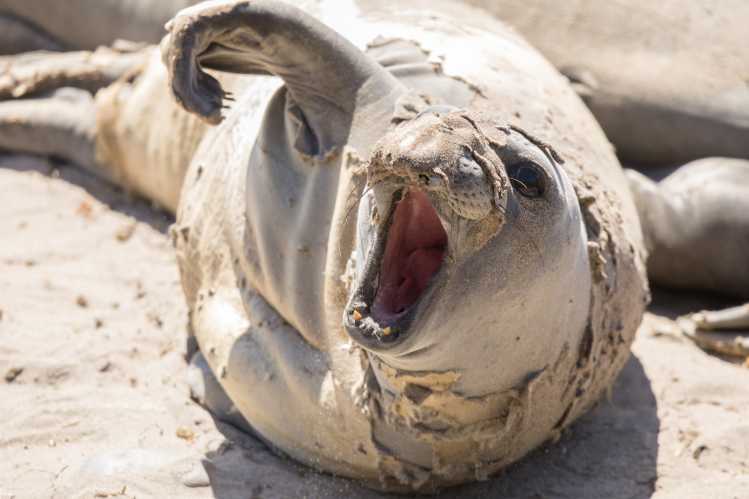
Elephant seals molt each year between April and August, shedding not only their hair but also the top layer of their skin. This is known as a catastrophic molt. They return to rookery beaches for a few weeks while molting. Females molt in the spring, juveniles in the early summer and males in the late summer.
When and Where to See Elephant Seals in California
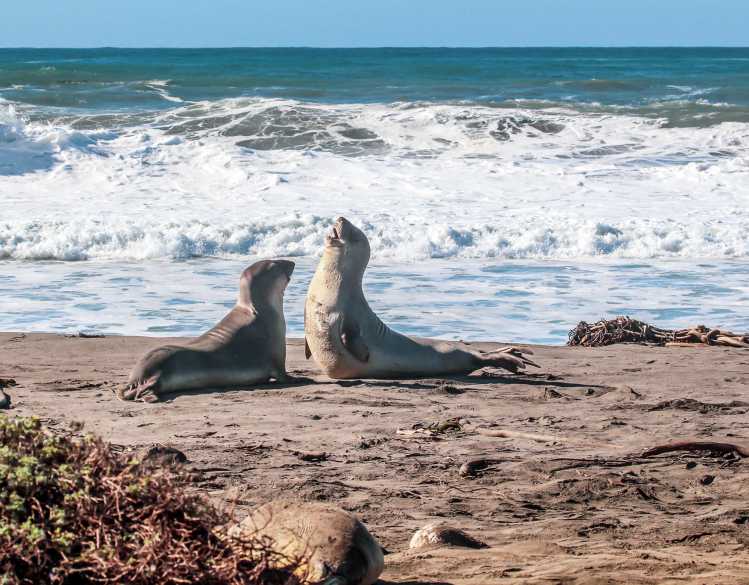
Seeing elephant seals in the wild is a truly remarkable experience, and coastal viewpoints in California offer breathtaking sights of this species that you won’t want to miss. As you watch these large, blubbery mammals interact in their natural habitat, the experience is made even more special knowing that you are witnessing a conservation success story.
Large colonies of northern elephant seals can be found on their breeding grounds along the California coast and offshore islands, such as Año Nuevo, Piedras Blancas, Point Reyes and the Channel Islands. Visiting areas along the coast offer spectacular views of these animals during peak haul-out seasons and year-round.


