The Marine Mammal Center Responds to Largest Domoic Acid Outbreak in Its History
- Domoic acid
The Marine Mammal Center has documented more than 300 cases of domoic acid poisoning in marine mammals this year, marking the largest outbreak since the organization’s founding in 1975. This naturally occurring toxin can have severe impacts on marine mammals, causing tremors, seizures, and heart failure if left untreated. The scale of this outbreak underscores both the threats these animals face in our ocean and the challenges involved in addressing them.
A record-setting rescue season
Early this summer, our trained staff and volunteers began responding to increased numbers of marine mammals suffering from domoic acid, with responses peaking in early September. So far this year, we have documented more than 300 cases of domoic acid poisoning, a stark contrast to the approximately 75 to 90 seen in a typical year.
The outbreak caused a dramatic increase in call volume, with our response hotline receiving more than 600 calls on the busiest days, nearly four times what our team usually sees. This strained response teams, comprised mainly of volunteers, across our roughly 600-mile California range, with Monterey, Santa Cruz, and San Mateo counties experiencing the greatest response activity.
While response activity has begun to decline in October outside of San Mateo County, our experts continue to receive an elevated number of hotline calls while also caring for marine mammals suffering from domoic acid and other ailments at our hospital.
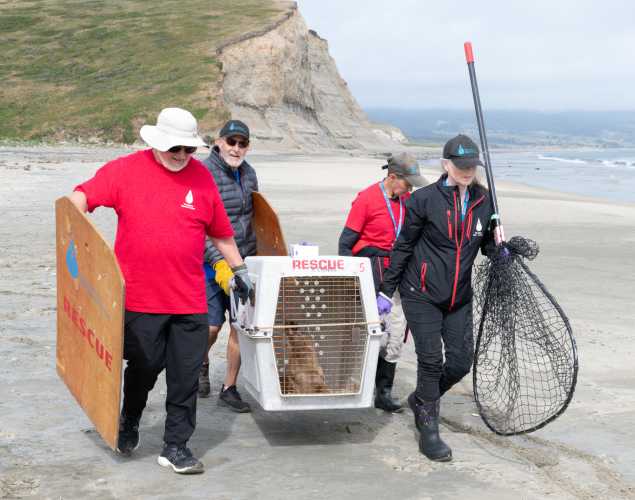
Each response requires specialized training and can be both physically and emotionally demanding. A single adult sea lion weighs hundreds of pounds, and rescue may require four to six trained responders traveling a mile or more on foot with necessary equipment. Our trained responders also experience the heartbreak of this powerful neurotoxin, often witnessing animals seize while attempting to help them.
Despite the decline in response activity, it remains unclear when the outbreak will fully subside. Our team continues to respond to animals in need and care for marine mammals at our hospital.
What is domoic acid toxicosis?
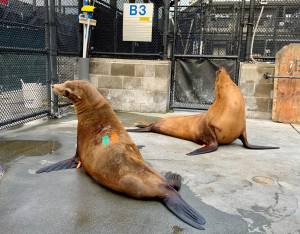
Domoic acid is produced under certain environmental conditions by a type of algae called Pseudo-nitzschia australis. This neurotoxin accumulates in smaller prey animals, like sardines and shellfish, which are then eaten by marine mammals in large quantities. As the toxin accumulates in their body, it attacks the brain and heart causing lethargy, disorientation, and tremors. If left untreated, animals can suffer more serious effects like seizures and fatal heart complications.
Treatment for animals exposed to the toxin may include anti-seizure medications, fluids, and uncontaminated fish to support animals as their bodies clear the toxin. While some animals recover with treatment, those repeatedly exposed to the toxin are more likely to experience neurological and cardiac damage so severe that they no longer respond to treatment and either die or are humanely euthanized.
These events have long affected California’s coast, with the Center first diagnosing domoic acid toxicosis in marine mammals in 1998, but the timing and intensity of these outbreaks have become increasingly unpredictable.
Understanding an unpredictable ocean
California sea lions are considered a sentinel species, meaning their health can provide invaluable insight into the condition of our shared ocean. As our ocean experiences rising temperatures and environmental pressures, marine mammals offer scientists a critical view into a changing ecosystem.
Sea lions are among the first species to be impacted by these harmful algal blooms and consume many of the same types of seafood that people eat. Data from domoic acid outbreaks like this one, help inform public health officials when seafood warnings need to be issued to protect human health. Domoic acid can cause serious illness in humans, including amnesic shellfish poisoning, which can be life-threatening.
These animals are sentinels of the ocean, and an outbreak of this scale is a clear demonstration of the challenges affecting the ocean habitat that these animals and others rely on for survival.
This year’s record-setting domoic acid outbreak comes on the heels of another unprecedented challenge: a record-breaking leptospirosis outbreak in California sea lions in 2025. Together, these events emphasize the growing complexity of challenges marine mammals face and the importance of monitoring their health over time.
While domoic acid toxicosis and leptospirosis have different causes, both highlight the importance of understanding the environmental conditions that affect marine mammal health. By studying stranded animals, monitoring disease patterns, and collaborating with research partners, the Center advances our collective understanding of the environmental factors affecting our shared ocean ecosystem.
“These animals are sentinels of the ocean, and an outbreak of this scale is a clear demonstration of the challenges affecting the ocean habitat that these animals and others rely on for survival,” says Sarah Pattison, RVT and the Center’s Director of Hospital Operations. “Each animal we care for teaches us about the environmental stressors they are faced with. This insight paints a clearer picture of what’s happening in our changing ocean, informs how we care for these animals in need, and is an important reminder of the interconnectivity of humans, animals, and the environment.”
How you can help
Community plays an essential role in locating animals in distress by reporting sick or injured marine mammals to our hotline, allowing trained responders to assess the situation and determine appropriate next steps.
If you encounter a marine mammal that appears sick, injured, disoriented, or otherwise in need along the California coast:
- Keep your distance. Stay at least 150 feet away. Sick or injured wildlife can behave unpredictably.
- Keep pets leashed and away from wildlife.
- Never touch or move an animal. Do not attempt to return a stranded animal to the water.
- Call the experts. Report the animal to The Marine Mammal Center’s response hotline at 415-289-SEAL (7325).
- Please be patient. Response teams continue to manage an unusually high volume of calls and rescues.
Each report helps trained responders identify animals in need, and community support helps advance our mission to advance global ocean health through marine mammal rescue and rehabilitation, scientific research, and conservation education.
This work is possible thanks to the generosity of caring people like you. You can support sea lions, seals, and other wildlife with a gift that helps provide rescue, critical care, and further research to address threats to our ocean.
Yes, I want to save a life!
You’ll be giving patients suffering from domoic acid poisoning the best possible care at our state-of-the-art hospital.
See Our Latest News
{"image":"\/Animals\/Wild\/Humpback whale\/humpback-whale-spout-by-bill-hunnewell-c-the-marine-mammal-center.jpg","alt":"Humpback whale spout","title":"A Collaboration to Protect Whales and Support California\u2019s Dungeness Crab Fishery","link_url":"https:\/\/www.marinemammalcenter.org\/news\/collaboration-to-protect-whales-and-support-californias-dungeness-crab-fishery","label":"Press Release","date":"2026-10-22 02:00:00"}
A Collaboration to Protect Whales and Support California’s Dungeness Crab Fishery
October 22, 2026
Read More{"image":"\/People\/Action\/Response\/cropped-images\/c-common-dolphin93026cuesta-inlet-in-morro-bayphoto-c-the-marine-mammal-center-noaa-mmhsrp-24359-0-399-1270-992-1790883642.jpg","alt":"Stranded dolphin response","title":"Three Common Dolphins Freed from Mudflats in Morro Bay","link_url":"https:\/\/www.marinemammalcenter.org\/news\/three-common-dolphins-freed-from-mudflats-in-morro-bay","label":"News Update","date":"2026-10-02 02:00:00"}
{"image":"\/Animals\/Wild\/Humpback whale\/cropped-images\/a-humpback-whalesf-bay91526photo-by-norely-faz-c-the-marine-mammal-center-noaa-permit-26532-772-1-1270-992-1789760973.png","alt":"Humpback whale Rio","title":"Humpback Whale \"Rio\" Spotted in the Sacramento-San Joaquin Delta","link_url":"https:\/\/www.marinemammalcenter.org\/news\/humpback-whale-rio-spotted-in-the-sacramento-san-joaquin-delta","label":"News Update","date":"2026-09-18 12:10:00"}
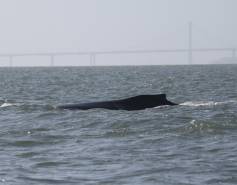
Humpback Whale "Rio" Spotted in the Sacramento-San Joaquin Delta
September 18, 2026
Read More{"image":"\/Animals\/Patients\/California sea lions\/2024\/d-california-sea-lionsin-treatment-for-domoic-acidsausalito72624photo-by-giancarlo-rulli-c-the-marine-mammal-center.jpg","alt":"California sea lions","title":"SF GATE: Sick, disoriented sea lions are washing up on California beaches","link_url":"https:\/\/www.marinemammalcenter.org\/news\/sf-gate-sick-disoriented-sea-lions-are-washing-up-on-california-beaches","label":"In the News","date":"2026-09-01 10:39:22"}
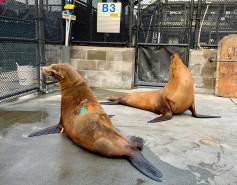
SF GATE: Sick, disoriented sea lions are washing up on California beaches
September 1, 2026
Read More