Three Common Dolphins Freed from Mudflats in Morro Bay
On Tuesday morning, September 29, our San Luis Obispo response team received reports of five dolphins in Morro Bay and dispatched trained responders to the area. The dolphins were swimming freely, actively foraging, and in good body condition, and our team continued monitoring the animals throughout the day as they remained in Cuesta Inlet.
Because these were healthy, wild animals behaving normally, the best-case scenario was for the dolphins to make their way out of the inlet on their own. Our team stayed on the scene to monitor the animals while simultaneously planning potential intervention options.
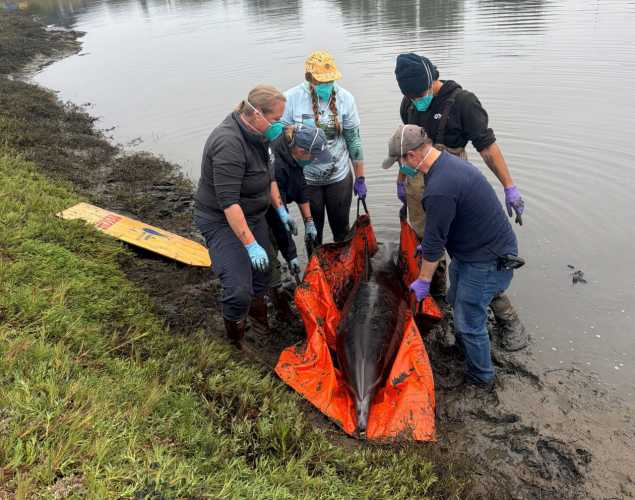
Unfortunately, the animals did not navigate to deeper waters as the tide went out, and four of them became stranded in the mudflats. The dynamic conditions of a setting sun, outgoing tide, and active animals presented significant risks to both animal and human safety that our veterinary experts weighed heavily. With another high tide expected before sunrise, offering them another opportunity to free themselves, the dolphins remained in the cool, wet mud overnight.
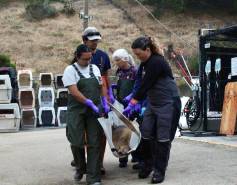
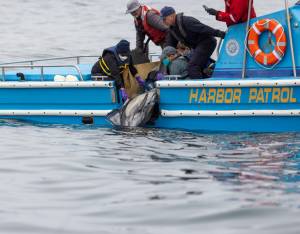
At first light the following morning, Wednesday, September 30, our trained responders returned to the area and were able to safely rescue three of the four animals that had stranded. The fifth dolphin seen Tuesday could not be located. The team successfully released the three rescued dolphins with help from our partners at Morro Bay Harbor Department. The fourth dolphin was found deceased and was collected so a necropsy, or animal autopsy, investigation could help answer why this happened, including testing for underlying health conditions or toxin exposure.
While we do not yet have all the answers, we do know that climate change and marine heatwaves can affect marine mammals like dolphins both directly and indirectly, altering ocean conditions.
Over our 50-year history, we know marine heatwaves, particularly when coupled with normal climate patterns like El Niño, can cause a shift in the distribution of fish and other prey these animals rely on. In turn, marine mammals may adapt their feeding behavior to seek food sources in new areas. Although domoic acid levels are currently low off the immediate San Luis Obispo County coast, dolphins can travel long distances and may encounter the toxin elsewhere. It’s currently unknown whether domoic acid had any impact on these animals, but there is an ongoing harmful algal bloom event in Central and Northern California that our trained experts have been responding to since early this summer.
We understand how distressing scenes like this can be. The best thing you can do to help is to give these animals plenty of space and not intervene to avoid stressing them further.
- Keep your distance: Stay at least 100 yards away, in accordance with NOAA marine wildlife viewing guidelines.
- Give dolphins a clear path: Slow down and never chase, follow, surround or cut across their path as the tides rise.
- Keep pets away: Keep dogs and other pets away from dolphins and the surrounding area to minimize noise and stress.
- Do not fly drones: Drones should not be flown over or near dolphins, as they can cause stress and disturbance.
- Report sightings: The best way to enjoy dolphins is to give them space and let them decide where they go. The public can also help researchers and wildlife experts by reporting sightings through our whale and dolphin sightings page.
As the world’s largest marine mammal hospital, we know firsthand that we cannot save every animal reported to us, but we are dedicated to making each one of our patients’ lives matter.
We are deeply grateful to our partners and the Los Osos community, whose support made these rescues possible. Our dedicated team, comprised largely of volunteers, also shares the grief and heartbreak for the dolphin that did not make it and is appreciative of the public’s understanding that every possible avenue to help these animals was carefully considered and explored.
You can sign up to volunteer, learn more about conservation efforts, or shop your support to help ensure sick and injured marine mammals get the critical care they need.
Yes, I want to save a life!
You’ll be giving sick and injured animals the best possible care at the Center’s state-of-the-art hospital. With your gift today, you are giving a patient a second chance at life in the wild.
See Our Latest News
{"image":"\/Animals\/Wild\/Humpback whale\/cropped-images\/a-humpback-whalesf-bay91526photo-by-norely-faz-c-the-marine-mammal-center-noaa-permit-26532-772-1-1270-992-1789760973.png","alt":"Humpback whale Rio","title":"Humpback Whale \"Rio\" Spotted in the Sacramento-San Joaquin Delta","link_url":"https:\/\/www.marinemammalcenter.org\/news\/humpback-whale-rio-spotted-in-the-sacramento-san-joaquin-delta","label":"News Update","date":"2026-09-18 12:10:00"}
Humpback Whale "Rio" Spotted in the Sacramento-San Joaquin Delta
September 18, 2026
Read More{"image":"\/Animals\/Patients\/California sea lions\/2024\/d-california-sea-lionsin-treatment-for-domoic-acidsausalito72624photo-by-giancarlo-rulli-c-the-marine-mammal-center.jpg","alt":"California sea lions","title":"SF GATE: Sick, disoriented sea lions are washing up on California beaches","link_url":"https:\/\/www.marinemammalcenter.org\/news\/sf-gate-sick-disoriented-sea-lions-are-washing-up-on-california-beaches","label":"In the News","date":"2026-09-01 10:39:22"}
SF GATE: Sick, disoriented sea lions are washing up on California beaches
September 1, 2026
Read More{"image":"\/Animals\/Wild\/Sea otter\/cropped-images\/sea-otter-shutterstock-118-0-2496-1950-1604015482.jpg","alt":"sea otter eating clams","title":"What Do Sea Otters Eat? And Other Otter Trivia","link_url":"https:\/\/www.marinemammalcenter.org\/news\/what-do-sea-otters-eat-and-other-otter-trivia","label":"News Update","date":"2026-09-01 02:00:00"}
{"image":"\/People\/Action\/Volunteers\/h-california-sea-lion-transportdomoic-acidslo-countydomoic-acid80524photo-by-giancarlo-rulli-c-the-marine-mammal-center.jpg","alt":"Volunteers transporting a California sea lion","title":"An Update on Domoic Acid Poisoning on the California Coast","link_url":"https:\/\/www.marinemammalcenter.org\/news\/an-update-on-domoic-acid-poisoning-on-the-california-coast","label":"News Update","date":"2026-08-28 02:00:00"}