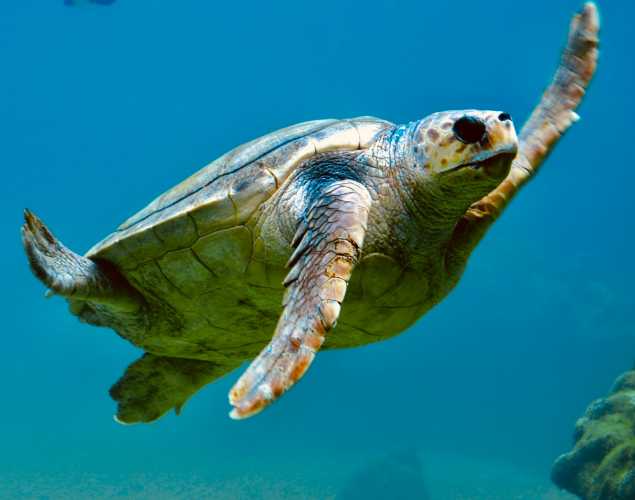
Clinicopathological Findings in Sea Turtles Assessed During the Deepwater Horizon Oil Spill Response
- Pathology
- Pollution
Abstract
During the BP Deepwater Horizon (DWH) oil spill in 2010, 319 live oiled sea turtles were rescued and admitted to rehabilitation centers for decontamination and veterinary care. Most turtles were small, surface-pelagic juveniles that were collected from oiled habitat distant from shore. Serial hematology, plasma biochemistry, and blood gas analyses were reviewed to characterize abnormalities relative to observed degree of oiling. Clinicopathological abnormalities upon admission indicated acute, nonspecific metabolic and osmoregulatory derangements that were attributable to a combination of events including stress, exertion, physical exhaustion, and dehydration related to oiling, capture, and transport. Specific toxicological effects reported in other taxa were not observed. Initial point-of-care blood data from one rescue center were evaluated using clinical assessment of physiological status for all turtles of all species with available data for pH, pCO2, sodium, and potassium. In addition, a prognostic model that was specifically developed for cold-stunned Kemp's ridley sea turtles Lepidochelys kempii was applied to oiled Kemp's ridley turtles from one center. Thirty-six percent of oiled turtles were identified as physio - logically de ranged based on a clinical assessment of their physiological status, and 25% of oiled Kemp's ridley sea turtles exceeded the mortality risk threshold of the prognostic model. These results indicate that the physiological derangements in these animals were relatively severe and clinically relevant. Based on observations during the DWH spill, adverse physiological effects in sea turtles may be an important consequence of stress, exertion, physical exhaustion, and de - hydration secondary to oiling, capture, and transport.
Stacey, N.I., Field, C.L., Staggs, L., MacLean, R.A., Stacey, B.A., Keene, J., Cacela, D., Pelton, C., Cray, C., Kelley, M., Holmes, S., Innis, C.J. 2017. Clinicopathological findings in sea turtles assessed during the Deepwater Horizon oil spill response. Endangered Species Research. 33: 25-37.
Meet The Experts
{"image":"\/People\/Portrait\/cara-field.jpg","alt":"Cara Field","title":"Cara Field","text":"Senior Director, Conservation Medicine","link_url":"https:\/\/www.marinemammalcenter.org\/person\/cara-field","link_text":"Read Bio"}
Related Publications
{"image":"\/Animals\/Patients\/Harbor seals\/2019\/cropped-images\/hs-aquapup-1-by-bill-hunnewell-c-the-marine-mammal-center-164-4-2324-1816-1606771695.jpg","alt":"two harbor seals","title":"Effects of Mercury Exposure in Harbor Seal Pups","link_url":"https:\/\/www.marinemammalcenter.org\/publications\/effects-of-mercury-exposure-in-harbor-seal-pups","label":"Research Paper"}
{"image":"\/Animals\/Patients\/California sea lions\/2018\/cropped-images\/csl-leadbelly-by-bill-hunnewell-c-the-marine-mammal-center-664-0-2502-1954-1607626905.jpg","alt":"California sea lion","title":"Contaminant Exposure and Herpesvirus Associated with Cancer in Wild Sea Lions","link_url":"https:\/\/www.marinemammalcenter.org\/publications\/contaminant-exposure-and-herpesvirus-associated-with-cancer-in-wild-sea-lions","label":"Research Paper"}
Contaminant Exposure and Herpesvirus Associated with Cancer in Wild Sea Lions
Read More{"image":"\/Animals\/Wild\/Harbor seal\/cropped-images\/harbor-seals-shutterstock-307-0-4076-3184-1645666025.jpg","alt":"harbor seal moms and pups on a beach","title":"Fetal Mercury Concentrations in Harbor Seals: Associated Drivers and Outcomes","link_url":"https:\/\/www.marinemammalcenter.org\/publications\/fetal-mercury-concentrations-in-harbor-seals-associated-drivers-and-outcomes","label":"Research Paper"}

Fetal Mercury Concentrations in Harbor Seals: Associated Drivers and Outcomes
Read More{"image":"\/Animals\/Wild\/Humpback whale\/cropped-images\/humpback-whale-sea-lions-photo-c-bill-hunnewell-190-2-2774-2167-1659123832.jpg","alt":"humpback whales and California sea lions feeding","title":"Aquatic Mammals","link_url":"https:\/\/www.marinemammalcenter.org\/publications\/aquatic-mammals","label":"Research Paper"}
Related News
{"image":"\/Misc\/Graphics\/Ocean Plastic Pollution.jpeg","alt":"plastic pollution floating in the ocean","title":"NBC Bay Area: Plastic pollution causing a sea of trouble","link_url":"https:\/\/www.marinemammalcenter.org\/news\/nbc-plastic-pollution-causing-a-sea-of-trouble","label":"In the News","date":"2024-11-26 01:00:00"}

{"image":"\/Places\/Coastal landscapes\/cropped-images\/shutterstock_palos verdes ddt-0-1-1270-992-1728333594.jpg","alt":"view of Palos Verdes coastline","title":"Newsweek: Toxic Contamination in Our Oceans Can Reach Our Kitchen Tables | Opinion","link_url":"https:\/\/www.marinemammalcenter.org\/news\/newsweek-opinion-toxic-contamination-in-our-oceans-can-reach-our-kitchen-tables","label":"In the News","date":"2024-10-07 02:00:00"}
Newsweek: Toxic Contamination in Our Oceans Can Reach Our Kitchen Tables | Opinion
October 7, 2024
Read More{"image":"\/Animals\/Patients\/Releases\/cropped-images\/csl-release-by-bill-hunnewell-c-the-marine-mammal-center-278-2-3752-2931-1715194127.jpg","alt":"two California sea lions return to the wild","title":"Voice of America: Sea Mammals and Ocean Health","link_url":"https:\/\/www.marinemammalcenter.org\/news\/voice-of-america-sea-mammals-and-ocean-health","label":"In the News","date":"2024-04-17 02:00:00"}

{"image":"\/Places\/Coastal landscapes\/cropped-images\/underwater-barrel-shutterstock-328-0-4424-3456-1651790853.jpg","alt":"rusty barrel underwater and covered with algae","title":"The Hill: 'Under the Sea, Out of Mind' Has Turned Into a Ticking Time Bomb","link_url":"https:\/\/www.marinemammalcenter.org\/news\/the-hill-under-the-sea-out-of-mind-has-turned-into-a-ticking-time-bomb","label":"In the News","date":"2022-05-03 02:00:00"}
The Hill: 'Under the Sea, Out of Mind' Has Turned Into a Ticking Time Bomb
May 3, 2022
Read More