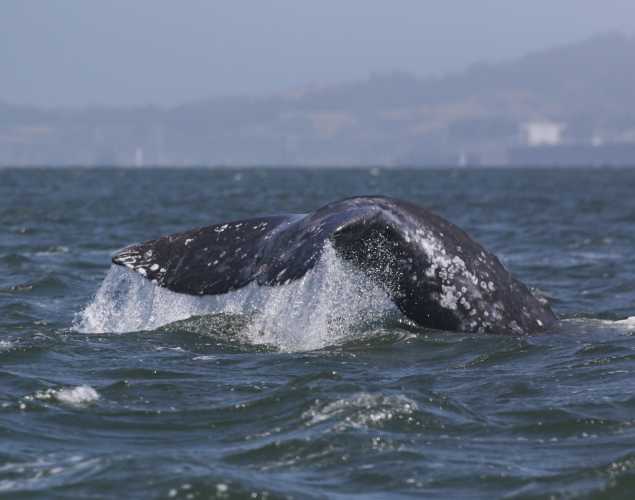
Gray whales (Eschrichtius robustus) in San Francisco Bay experience high mortality and have limited affiliation to known foraging groups
- Malnutrition
- Climate change
Abstract
Terrestrial and marine species are exhibiting distributional shifts due to climate change and resource availability. As food webs are impacted, some species have moved into areas of increased human activity, encountering anthropogenic hazards. A coastal marine species that undertakes a long migration between breeding and foraging ranges, the Eastern North Pacific (ENP) population of gray whales (Eschrichtius robustus) is especially vulnerable to changes. Subgroups of ENP gray whales, including the Pacific Coast Feeding Group and the (Puget) Sounders, have adapted to exploit alternative feeding grounds as prey availability declines in the Arctic. Novel to known migration phenology, gray whales have been observed seasonally since 2018 in San Francisco Bay (SF Bay), California. We evaluated subgroup identity and mortality of gray whales in SF Bay from 2018– 2025 using photo-identification. Data were collected through vessel-based surveys, opportunistic effort, and community submissions. We identified 114 individual whales of which eight were matched to a subgroup, indicating gray whales utilizing SF Bay are not merely a range extension by foraging subgroups. Only four gray whales were resighted within SF Bay between years. Using photographs, 21 individuals were successfully matched to carcasses and a minimum mortality rate of 18% was determined. Blunt and/or sharp force trauma consistent with vessel strike was determined to be the cause of death for 30 of 70 carcasses, and for nine of 11 matched animals where a cause of death was determined. Sounder and PCFG matched whales were more likely to survive SF Bay than ENP individuals, though minimum length of stay did not influence mortality. This work confirms that gray whales entering SF Bay are highly susceptible to vessel strike mortality and highlights a crucial need to identify and implement adaptive management strategies to mitigate injuries and mortality as whales continue to utilize novel habitat.
Slaathaug, J. M., Lane, R. S., Keener, W., Pérez, A., Flannery, M., Webber, M. A., Grimes, A., Wilkin, A. M., O’Hern, J. E., Duignan, P. J., Calambokidis, J., & Crocker, D. E. (2026). Gray whales (Eschrichtius robustus) in San Francisco Bay experience high mortality and have limited affiliation to known foraging groups. Frontiers in Marine Science, 13, 1775666. https://doi.org/10.3389/fmars.2026.1775666
Meet The Experts
{"image":"\/People\/Portrait\/cropped-images\/PD_Gray whale Pacifica_IMG_0552-0-0-1270-992-1775170630.jpeg","alt":"Padraig Duignan","title":"P\u00e1draig Duignan","text":"Senior Director, Research Pathology","link_url":"https:\/\/www.marinemammalcenter.org\/person\/padraig-duignan","link_text":"Read Bio"}
{"image":"\/People\/Portrait\/cropped-images\/marc-webber-0-196-1204-940-1618436847.jpg","alt":"Marc Webber","title":"Marc Webber","text":"Cetacean Field Research Associate","link_url":"https:\/\/www.marinemammalcenter.org\/person\/marc-webber","link_text":"Read Bio"}
{"image":"\/People\/Portrait\/cropped-images\/bill-keener-0-0-3030-2314-1601930964.jpg","alt":"Bill Keener","title":"Bill Keener","text":"Cetacean Field Research Associate","link_url":"https:\/\/www.marinemammalcenter.org\/person\/bill-keener","link_text":"Read Bio"}
Related Publications
{"image":"\/Animals\/Patients\/Guadalupe fur seals\/2020\/cropped-images\/gfs-pippin-by-bill-hunnewell-c-the-marine-mammal-center-noaa-permit-18786-111-120-3738-2920-1602702191.jpg","alt":"Guadalupe fur seal Pippin","title":"Understanding the Impacts of Climate Change on Threatened Guadalupe Fur Seals","link_url":"https:\/\/www.marinemammalcenter.org\/publications\/understanding-the-impacts-of-climate-change-on-threatened-guadalupe-fur-seals","label":"Research Paper"}
Understanding the Impacts of Climate Change on Threatened Guadalupe Fur Seals
Read More{"image":"\/Animals\/Wild\/Steller sea lion\/cropped-images\/steller-sea-lion-harem-shutterstock-648-0-4424-3456-1603916879.jpg","alt":"Group of Steller sea lions","title":"Algal Toxins in Alaskan Marine Mammals Foraging in a Changing Environment","link_url":"https:\/\/www.marinemammalcenter.org\/publications\/algal-toxins-in-alaskan-marine-mammals-foraging-in-a-changing-environment","label":"Research Paper"}
{"image":"\/Animals\/Wild\/Bottlenose dolphin\/bottlenose-dolphins-leaping-shutterstock.jpg","alt":"dolphins leaping out of the water","title":"Fresh Water Skin Disease in Dolphins","link_url":"https:\/\/www.marinemammalcenter.org\/publications\/fresh-water-skin-disease-in-dolphins","label":"Research Paper"}
{"image":"\/Animals\/Wild\/Bottlenose dolphin\/bottlenose-dolphin-by-bill-keener-c-the-marine-mammal-center-1.jpg","alt":"Bottlenose dolphin","title":"Effects of Low Salinity Water Exposure on Bottlenose Dolphins","link_url":"https:\/\/www.marinemammalcenter.org\/publications\/effects-of-low-salinity-water-exposure-on-bottlenose-dolphins","label":"Research Paper"}
Related News
{"image":"\/Misc\/Graphics\/cropped-images\/climate-change-graphic-giant-earth-shutterstock-1798-6-5113-3994-1680046432.jpg","alt":"An Earth Day graphic of people holding the planet, recycling, planting a tree and moving a solar panel.","title":"5 Ways to Celebrate Earth Day","link_url":"https:\/\/www.marinemammalcenter.org\/news\/5-ways-to-celebrate-earth-day","label":"News Update","date":"2025-04-18 11:21:08"}

{"image":"\/People\/Action\/Education\/cropped-images\/youth crew education-79-4-1270-992-1728322151.jpg","alt":"A student stands behind an education table near images of marine mammals, talking to three children and one adult. ","title":"Why Should We Talk About Climate Change?","link_url":"https:\/\/www.marinemammalcenter.org\/news\/why-should-we-talk-about-climate-change","label":"News Update","date":"2024-10-07 02:00:00"}
{"image":"\/Animals\/Wild\/Sea otter\/cropped-images\/01. Sea otter with kelp-51-2-1270-992-1725043723.jpg","alt":"A sea otter floats above a kelp forest. ","title":"How Sea Otters Can Help Save the Planet","link_url":"https:\/\/www.marinemammalcenter.org\/news\/how-sea-otters-can-help-save-the-planet","label":"News Update","date":"2024-08-30 02:00:00"}
{"image":"\/Animals\/Patients\/California sea lions\/cropped-images\/LA Times Front Page 8.13.24-340-15-1270-992-1723588213.png","alt":"LA Times Front Page Domoic Acid Sea Lions","title":"LA Times: Neurotoxin is Poisoning Large Numbers of Sea Lions","link_url":"https:\/\/www.marinemammalcenter.org\/news\/la-times-neurotoxin-is-poisoning-large-numbers-of-sea-lions","label":"In the News","date":"2024-08-13 02:00:00"}