Understanding the Impacts of Climate Change on Threatened Guadalupe Fur Seals
- Species conservation
- Climate change
Abstract
The Guadalupe fur seal (GFS) currently is recovering from near extinction and prey availability is an important factor. Scat and stable isotope analyses (SIA) were used to assess GFS foraging on Guadalupe Island during 2013–2016. This period was characterized by normal (2013) ocean temperatures followed by warm conditions (2014–2016). Scat samples (~40/year) were collected for prey identification. Additionally, lanugo samples from 1‐month‐old pups (50/year) were processed for SIA (δ13C/δ15N). Interannual prey preferences were identified (ANOSIM, p < .05), including significant differences between 2013 and the anomalous years. The most important prey species among these years was the jumbo squid; followed by the neon flying squid (2014–2016). The GFS diet was more specialized in 2013–2015 and more generalized in 2016. Prey from higher trophic levels (determined by scat analysis) were consumed during 2014–2016, but with significantly lower δ13C/δ15N values than in 2013 (ANOVA, p < .05 for both isotope ratios). This pattern may indicate more northerly or offshore foraging areas, with the presence of oceanic prey (neon flying squid). The widest isotopic niche was observed in 2015 (2.2‰2), reflecting a broader foraging area. Our findings are an important step toward better understanding the impacts of climate change on the recovery of GFS.
Amador‐Capitanachi, M.J., Moreno‐Sánchez, X.G., Ventura‐Domínguez, P.D., Juárez‐Ruiz, A., González‐Rodríguez, E., Gálvez, C., Norris, T. and Elorriaga‐Verplancken, F.R., Ecological implications of unprecedented warm water anomalies on interannual prey preferences and foraging areas of Guadalupe fur seals. Marine Mammal Science.
Header image: photo by Bill Hunnewell © The Marine Mammal Center / NOAA permit #18786
Related Publications
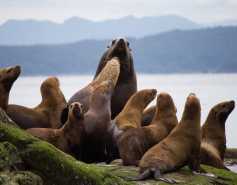
{"image":"\/Animals\/Wild\/Steller sea lion\/cropped-images\/steller-sea-lion-harem-shutterstock-648-0-4424-3456-1603916879.jpg","alt":"Group of Steller sea lions","title":"Algal Toxins in Alaskan Marine Mammals Foraging in a Changing Environment","link_url":"https:\/\/www.marinemammalcenter.org\/publications\/algal-toxins-in-alaskan-marine-mammals-foraging-in-a-changing-environment","label":"Research Paper"}
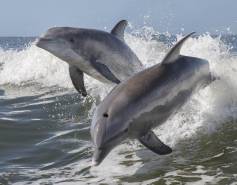
{"image":"\/Animals\/Wild\/Bottlenose dolphin\/bottlenose-dolphins-leaping-shutterstock.jpg","alt":"dolphins leaping out of the water","title":"Fresh Water Skin Disease in Dolphins","link_url":"https:\/\/www.marinemammalcenter.org\/publications\/fresh-water-skin-disease-in-dolphins","label":"Research Paper"}
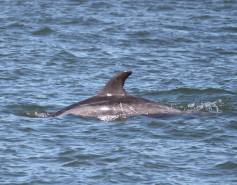
{"image":"\/Animals\/Wild\/Bottlenose dolphin\/bottlenose-dolphin-by-bill-keener-c-the-marine-mammal-center-1.jpg","alt":"Bottlenose dolphin","title":"Effects of Low Salinity Water Exposure on Bottlenose Dolphins","link_url":"https:\/\/www.marinemammalcenter.org\/publications\/effects-of-low-salinity-water-exposure-on-bottlenose-dolphins","label":"Research Paper"}
{"image":"\/People\/Action\/Education\/cropped-images\/youth-crew-climate-interpreter-photo-c-the-marine-mammal-center-92-1-4145-3238-1618620086.jpg","alt":"Youth Crew Climate Change Interpreter talks with guests","title":"Changing the Conversation on Climate","link_url":"https:\/\/www.marinemammalcenter.org\/publications\/changing-the-conversation-on-climate","label":"Research Paper"}
Related News
{"image":"\/Misc\/Graphics\/cropped-images\/climate-change-graphic-giant-earth-shutterstock-1798-6-5113-3994-1680046432.jpg","alt":"An Earth Day graphic of people holding the planet, recycling, planting a tree and moving a solar panel.","title":"5 Ways to Celebrate Earth Day","link_url":"https:\/\/www.marinemammalcenter.org\/news\/5-ways-to-celebrate-earth-day","label":"News Update","date":"2025-04-18 11:21:08"}

{"image":"\/People\/Action\/Education\/cropped-images\/youth crew education-79-4-1270-992-1728322151.jpg","alt":"A student stands behind an education table near images of marine mammals, talking to three children and one adult. ","title":"Why Should We Talk About Climate Change?","link_url":"https:\/\/www.marinemammalcenter.org\/news\/why-should-we-talk-about-climate-change","label":"News Update","date":"2024-10-07 02:00:00"}
{"image":"\/Animals\/Wild\/Sea otter\/cropped-images\/01. Sea otter with kelp-51-2-1270-992-1725043723.jpg","alt":"A sea otter floats above a kelp forest. ","title":"How Sea Otters Can Help Save the Planet","link_url":"https:\/\/www.marinemammalcenter.org\/news\/how-sea-otters-can-help-save-the-planet","label":"News Update","date":"2024-08-30 02:00:00"}
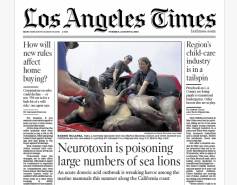
{"image":"\/Animals\/Patients\/California sea lions\/cropped-images\/LA Times Front Page 8.13.24-340-15-1270-992-1723588213.png","alt":"LA Times Front Page Domoic Acid Sea Lions","title":"LA Times: Neurotoxin is Poisoning Large Numbers of Sea Lions","link_url":"https:\/\/www.marinemammalcenter.org\/news\/la-times-neurotoxin-is-poisoning-large-numbers-of-sea-lions","label":"In the News","date":"2024-08-13 02:00:00"}