Fin Whale Transported from Santa Cruz Beach for Necropsy by Marine Mammal Response Partners
Fin Whale Transported from Santa Cruz Beach for Necropsy by Marine Mammal Response Partners
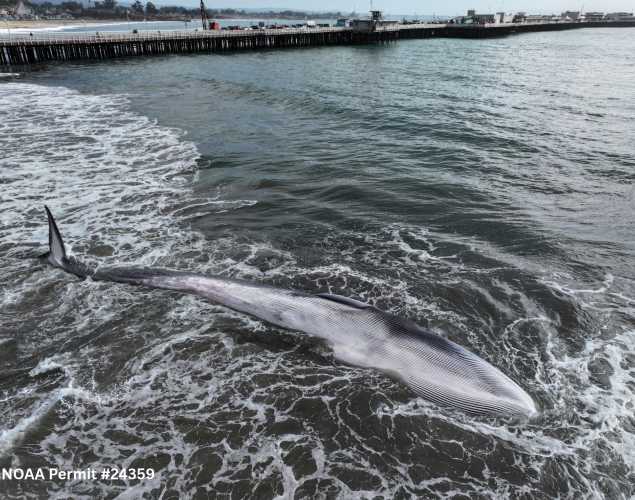
(SANTA CRUZ, Calif. – November 13, 2026) — Following the stranding and subsequent death of a fin whale at Cowell Beach in Santa Cruz on Thursday, November 12, city crews successfully transported the animal off the beach overnight. This allowed marine mammal response partners to conduct a necropsy, or animal autopsy, Friday morning to gather additional information about the whale's health and potential cause of death.
The necropsy was conducted at the City of Santa Cruz's Resource Recovery Facility by a collaborative team of experts from UC Santa Cruz's Long Marine Laboratory, the California Academy of Sciences, and The Marine Mammal Center.
The animal was confirmed to be a 55 foot, 58 thousand plus pound female fin whale, likely a juvenile. A postmortem examination confirmed that the whale was severely underweight and emaciated, consistent with a prolonged period of poor nutritional condition. While the examination provides important initial information about the animal's condition, the underlying cause of death remains undetermined.
During the necropsy, experts collected a series of tissue and other biological samples for further diagnostic testing, including histopathology, to evaluate the animal's health and investigate potential contributing factors. Results from these additional analyses will help provide a more complete understanding of the whale's condition but could take weeks to months to process.
The fin whale was first reported stranded in the surf at Cowell Beach on Thursday around 8 a.m. Marine mammal experts monitored the animal before it was pronounced dead at approximately 10:15 a.m.
Following its death, City of Santa Cruz crews worked closely with marine mammal response partners to develop and carry out a safe removal operation, ultimately transporting the animal off the beach overnight so that a necropsy could be performed.
A Collaborative Response
The successful removal and examination of this large whale required significant coordination, specialized expertise, and logistical support. UC Santa Cruz's Long Marine Laboratory, the California Academy of Sciences, and The Marine Mammal Center extend their sincere appreciation to the City of Santa Cruz and its crews for their tremendous efforts in securing the beach and surrounding area and providing logistical and equipment support. Their collective efforts made it possible for experts to conduct a thorough examination and gather valuable scientific information that can contribute to our understanding of fin whales and the challenges marine mammals face in our shared ocean.
About Fin Whales
Fin whales (Balaenoptera physalus) are the second-largest whale species in the world, behind only the blue whale, and can reach lengths of up to 85 feet. Known for their streamlined bodies and speed, they are found around the world, including along the California coast. Fin whales are listed as endangered under the federal Endangered Species Act and are protected under the Marine Mammal Protection Act. They primarily feed on small schooling fish, krill, and other tiny marine organisms by filtering large volumes of water through their baleen plates.
For more information or to set up an interview on this topic, please contact us at media@tmmc.org.
For breaking news about our whale responses as well as additional press materials, bookmark MarineMammalCenter.org/whale-stranding.
Learn More About Our Work Protecting Whales


Help protect whales!
You can support conservation efforts like these by donating to The Marine Mammal Center.
See Our Latest News
{"image":"\/Animals\/Patients\/Harbor seals\/2013\/cropped-images\/hs-bogey-by-ingrid-overgard-c-the-marine-mammal-center-371-0-2712-2118-1607385758.jpg","alt":"harbor seal Bogey","title":"Top Holiday Gifts for Ocean Lovers","link_url":"https:\/\/www.marinemammalcenter.org\/news\/top-eco-friendly-holiday-gifts-that-give-back","label":"News Update","date":"2026-11-02 01:00:00"}

{"image":"\/People\/Action\/Volunteers\/cslpangorescuephoto-c-niko-panagopoulos-35.jpg","alt":"California sea lion rescue","title":"The Marine Mammal Center Responds to Largest Domoic Acid Outbreak in Its History","link_url":"https:\/\/www.marinemammalcenter.org\/news\/the-marine-mammal-center-responds-to-largest-domoic-acid-outbreak-in-its-history","label":"News Update","date":"2026-10-28 02:00:00"}
The Marine Mammal Center Responds to Largest Domoic Acid Outbreak in Its History
October 28, 2026
Read More{"image":"\/Animals\/Wild\/Humpback whale\/humpback-whale-spout-by-bill-hunnewell-c-the-marine-mammal-center.jpg","alt":"Humpback whale spout","title":"A Collaboration to Protect Whales and Support California\u2019s Dungeness Crab Fishery","link_url":"https:\/\/www.marinemammalcenter.org\/news\/collaboration-to-protect-whales-and-support-californias-dungeness-crab-fishery","label":"Press Release","date":"2026-10-22 02:00:00"}
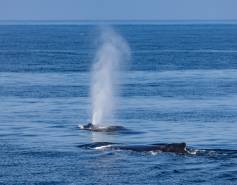
A Collaboration to Protect Whales and Support California’s Dungeness Crab Fishery
October 22, 2026
Read More{"image":"\/People\/Action\/Response\/cropped-images\/c-common-dolphin93026cuesta-inlet-in-morro-bayphoto-c-the-marine-mammal-center-noaa-mmhsrp-24359-0-399-1270-992-1790883642.jpg","alt":"Stranded dolphin response","title":"Three Common Dolphins Freed from Mudflats in Morro Bay","link_url":"https:\/\/www.marinemammalcenter.org\/news\/three-common-dolphins-freed-from-mudflats-in-morro-bay","label":"News Update","date":"2026-10-02 02:00:00"}