Sea Lion Irving Rescued on a San Francisco Street
- Malnutrition
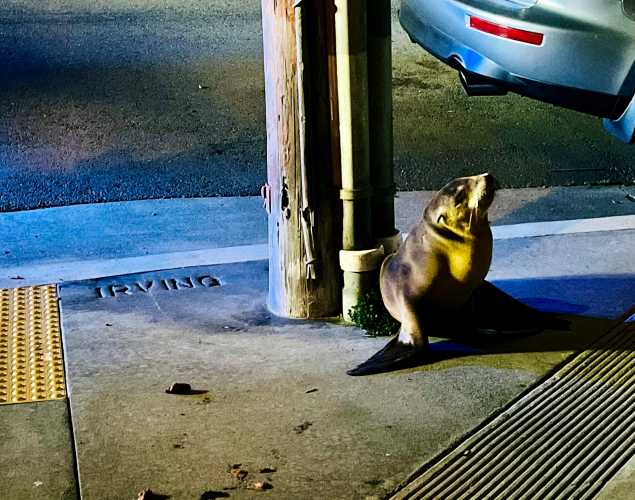
California sea lion Irving was stranded in San Francisco. Thanks to our partners and people like you, he was rescued and brought to our hospital, where he received expert medical care needed for a second chance at life.
During the early morning hours of April 16, one of our trained responders at The Marine Mammal Center joined officers from the San Francisco Police Department and San Francisco Recreation & Parks rangers in responding to a California sea lion pup found out of habitat near 48th and Irving streets in San Francisco.
Named Irving, the young male pup was safely corralled into a carrier crate, which was graciously provided by Ocean Avenue Animal Hospital, and transported to the San Francisco Parks and Recreation Ranger Station near Kezar Stadium. In consultation with our responder, Irving was held at the ranger station before a coordinated transfer to our Sausalito hospital mid-morning on April 16.
We are grateful for the dedication and support of our partners and people like you that allowed this young animal to be rescued in the wee hours of the morning, giving Irving a second chance.


Giving Irving the Best Possible Care
Irving soon underwent an admit exam by our veterinarians, who noted the pup was about 10 months old and severely malnourished. At just 40 pounds, he weighed about half of what he should have at his age. A series of blood samples were taken during the exam for diagnostic testing to determine whether there were underlying ailments.
California sea lions typically stay with their mothers for the first year of their lives, so not only was Irving small, but he was also too young to be on his own. As a skinny pup learning to forage, Irving had a long road to recovery at our hospital. Fortunately, he was active and quite feisty, which are positive behavioral signs for a sea lion pup.
“We are hopeful that in the coming weeks with continued specialized care that this pup starts to make positive strides toward recovery and release,” said Lauren Campbell, Animal Husbandry Manager at the Center.
At first, Irving was cared for in our hospital’s Intensive Quarantine Unit before he was transferred to a rehabilitation pool pen. Our animal care experts gently tube-fed him “fish smoothies” twice a day to boost hydration and weight. Once Irving grew stronger, he was transitioned to whole fish. It’s critical that pups like Irving learn survival skills like catching and eating whole fish on their own before being released.
After about two months in care, Irving transformed from a skinny young pup to a sea lion ready for life in the wild. He was released with a second chance at life alongside another rehabilitated patient, California sea lion Jade.
It’s thanks to caring people like you that Irving received the best possible care for a second chance at life.
Help feed a sea lion pup like Irving!
You’ll be giving sick and injured animals the best possible care at the Center’s state-of-the-art hospital. With your gift today, you are giving a patient a second chance at life in the wild.
See Our Latest News
{"image":"\/People\/Action\/Response\/cropped-images\/c-common-dolphin93026cuesta-inlet-in-morro-bayphoto-c-the-marine-mammal-center-noaa-mmhsrp-24359-0-399-1270-992-1790883642.jpg","alt":"Stranded dolphin response","title":"Three Common Dolphins Freed from Mudflats in Morro Bay","link_url":"https:\/\/www.marinemammalcenter.org\/news\/three-common-dolphins-freed-from-mudflats-in-morro-bay","label":"News Update","date":"2026-10-02 02:00:00"}
{"image":"\/Animals\/Wild\/Humpback whale\/cropped-images\/a-humpback-whalesf-bay91526photo-by-norely-faz-c-the-marine-mammal-center-noaa-permit-26532-772-1-1270-992-1789760973.png","alt":"Humpback whale Rio","title":"Humpback Whale \"Rio\" Spotted in the Sacramento-San Joaquin Delta","link_url":"https:\/\/www.marinemammalcenter.org\/news\/humpback-whale-rio-spotted-in-the-sacramento-san-joaquin-delta","label":"News Update","date":"2026-09-18 12:10:00"}
Humpback Whale "Rio" Spotted in the Sacramento-San Joaquin Delta
September 18, 2026
Read More{"image":"\/Animals\/Patients\/California sea lions\/2024\/d-california-sea-lionsin-treatment-for-domoic-acidsausalito72624photo-by-giancarlo-rulli-c-the-marine-mammal-center.jpg","alt":"California sea lions","title":"SF GATE: Sick, disoriented sea lions are washing up on California beaches","link_url":"https:\/\/www.marinemammalcenter.org\/news\/sf-gate-sick-disoriented-sea-lions-are-washing-up-on-california-beaches","label":"In the News","date":"2026-09-01 10:39:22"}
SF GATE: Sick, disoriented sea lions are washing up on California beaches
September 1, 2026
Read More{"image":"\/Animals\/Wild\/Sea otter\/cropped-images\/sea-otter-shutterstock-118-0-2496-1950-1604015482.jpg","alt":"sea otter eating clams","title":"What Do Sea Otters Eat? And Other Otter Trivia","link_url":"https:\/\/www.marinemammalcenter.org\/news\/what-do-sea-otters-eat-and-other-otter-trivia","label":"News Update","date":"2026-09-01 02:00:00"}