Newborn Hawaiian Monk Seal Pup Now Receiving Care
- Species conservation
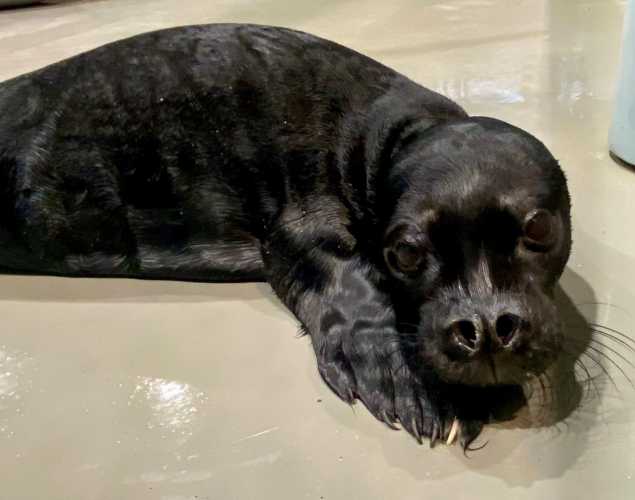
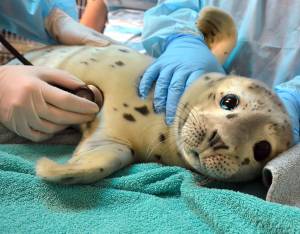
A newborn Hawaiian monk seal pup was recently brought to Ke Kai Ola, our hospital and conservation program based in Kailua-Kona, following a carefully planned intervention to give her the best possible chance at life. At 3 days old, RU72 is The Marine Mammal Center’s youngest Hawaiian monk seal patient ever admitted for care.
RU72 is the pup of a well-known seal on Hawai‘i Island, Waimanu (RW34), that is suspected to be the largest female seal in the entire population. Waimanu has given birth to at least four pups in the past, but possibly due to her size, she has unfortunately experienced significant challenges nursing. Her first pup in 2013 died after weaning due to a fishing hook ingestion and her following three pups died before weaning. Given Waimanu’s long and well-documented challenges nursing past pups, the Center’s experts worked with our partners at the National Oceanic and Atmospheric Administration (NOAA) to closely monitor the mother and pup from the moment RU72 was born.
“We opted to give them time as a pair to bond and figure things out. Waimanu showed a lot of strong mom behaviors. She was protective and stayed with her pup, and was seen vocalizing and bonding with her pup, but she rarely positioned herself to allow her pup to nurse,” says Dr. Sophie Whoriskey, the Center’s Associate Director of Hawai‘i Conservation Medicine.
Hawaiian monk seals are one of the most endangered seal species in the world, and every individual animal is crucial to the future of this population. After three days of monitoring the seals on the beach, our team observed many positive behaviors between the mother and her new pup, but no evidence of successful nursing. Unfortunately, this meant RU72’s life was at immediate risk.
“Guided by Waimanu’s history and our collective expertise in monk seal care, we made the difficult but necessary decision to intervene and bring the pup into rehabilitative care,” says Megan McGinnis, RVT, Director of Ke Kai Ola. To prevent RU72 from becoming medically unstable due to lack of nutrition, our experts secured the pup and transported her safely to Ke Kai Ola in consultation with our conservation partners at NOAA.
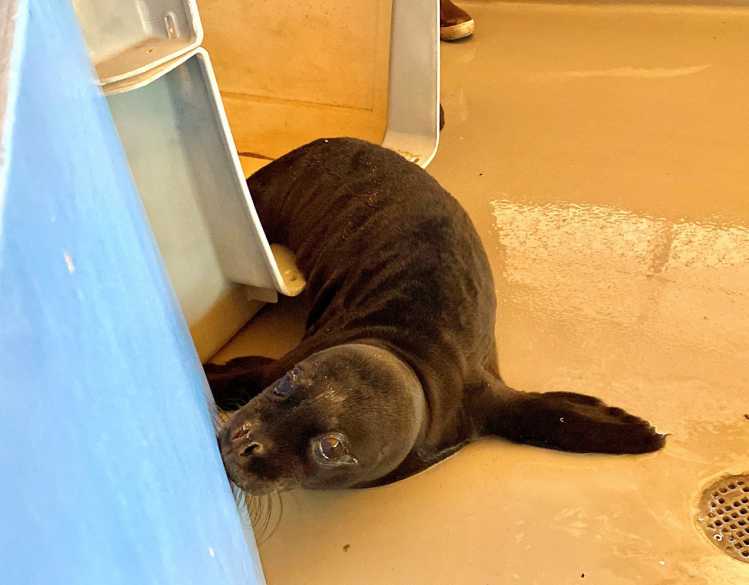
Upon arrival to our hospital, RU72 was bright, vocal and active—positive signs for her rehabilitation. Her umbilical cord had previously detached and is healing, and an initial exam indicated the pup is in good overall condition. RU72 is currently being housed with her pen-mate RU99, and the two monk seal pups have been socializing well. “She’s a healthy pup that just wasn’t getting the resources she needed to survive in the wild,” says Dr. Whoriskey.
Our veterinary staff and animal care volunteers have begun gradually introducing fish-mash and specialized formula, with tube feedings happening multiple times daily as RU72 acclimates and gains strength. As she starts growing teeth and spending more time in the pool, she will eventually begin learning how to catch and eat whole fish. As part of “fish school,” our experts may provide enrichment items like crates stuffed with fish, which mimic coral and challenge young monk seals to forage as they would in the wild.
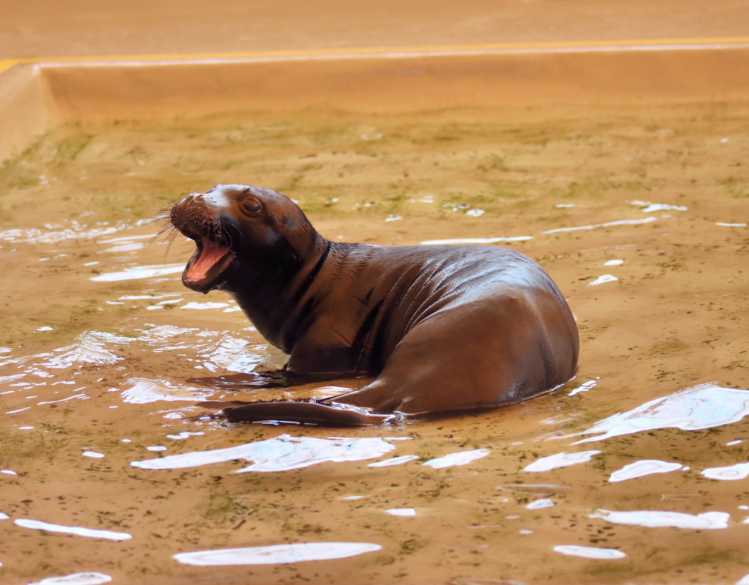
Waimanu is still being monitored on Hawai‘i Island to ensure her wellbeing following the separation. Our veterinary and response experts report that she appears healthy and has been seen resting and swimming in the same general area, which are positive signs.
For now, RU72 is steadily gaining weight and learning the skills needed to thrive in the wild. In the months ahead, once she receives a clean bill of health and can show our veterinary experts that she’s mastered the art of catching fish, she’ll be ready to return to her home on Hawai‘i Island with a second chance.
Your Support Makes This Possible
About 30 percent of Hawaiian monk seals are alive today directly due to conservation efforts led by NOAA and partners like the Center. This life-saving work is possible thanks to compassionate people like you.
Your support ensures our animal care experts have the resources needed to rehabilitate this endangered species, including young and vulnerable pups. In fact, our previous Hawaiian monk seal patient RK58 was rescued at just 19 days old due to malnutrition and a shortened nursing period. After months of life-saving care, he was successfully released on Kaua‘i.
Today, your support gives more pups like RU72 the care they need for a second chance. And as this young seal grows to be able to have pups of her own in the future, you are helping to ensure the continued growth of this endangered species.
Learn More About Our Work Protecting Hawaiian Monk Seals


Yes, I want to save a life!
You’ll be giving sick and injured animals the best possible care at the Center’s state-of-the-art hospital. With your gift today, you are giving a patient a second chance at life in the wild.
See Our Latest News
{"image":"\/People\/Action\/Response\/cropped-images\/c-common-dolphin93026cuesta-inlet-in-morro-bayphoto-c-the-marine-mammal-center-noaa-mmhsrp-24359-0-399-1270-992-1790883642.jpg","alt":"Stranded dolphin response","title":"Three Common Dolphins Freed from Mudflats in Morro Bay","link_url":"https:\/\/www.marinemammalcenter.org\/news\/three-common-dolphins-freed-from-mudflats-in-morro-bay","label":"News Update","date":"2026-10-02 02:00:00"}
{"image":"\/Animals\/Wild\/Humpback whale\/cropped-images\/a-humpback-whalesf-bay91526photo-by-norely-faz-c-the-marine-mammal-center-noaa-permit-26532-772-1-1270-992-1789760973.png","alt":"Humpback whale Rio","title":"Humpback Whale \"Rio\" Spotted in the Sacramento-San Joaquin Delta","link_url":"https:\/\/www.marinemammalcenter.org\/news\/humpback-whale-rio-spotted-in-the-sacramento-san-joaquin-delta","label":"News Update","date":"2026-09-18 12:10:00"}
Humpback Whale "Rio" Spotted in the Sacramento-San Joaquin Delta
September 18, 2026
Read More{"image":"\/Animals\/Patients\/California sea lions\/2024\/d-california-sea-lionsin-treatment-for-domoic-acidsausalito72624photo-by-giancarlo-rulli-c-the-marine-mammal-center.jpg","alt":"California sea lions","title":"SF GATE: Sick, disoriented sea lions are washing up on California beaches","link_url":"https:\/\/www.marinemammalcenter.org\/news\/sf-gate-sick-disoriented-sea-lions-are-washing-up-on-california-beaches","label":"In the News","date":"2026-09-01 10:39:22"}
SF GATE: Sick, disoriented sea lions are washing up on California beaches
September 1, 2026
Read More{"image":"\/Animals\/Wild\/Sea otter\/cropped-images\/sea-otter-shutterstock-118-0-2496-1950-1604015482.jpg","alt":"sea otter eating clams","title":"What Do Sea Otters Eat? And Other Otter Trivia","link_url":"https:\/\/www.marinemammalcenter.org\/news\/what-do-sea-otters-eat-and-other-otter-trivia","label":"News Update","date":"2026-09-01 02:00:00"}