The Marine Mammal Center and San Francisco Harbor Safety Committee Pilot New Vessel Operator Training Program
- Behavior
The Marine Mammal Center and San Francisco Harbor Safety Committee Pilot New Vessel Operator Training Program to Improve Whale Safety in San Francisco Bay
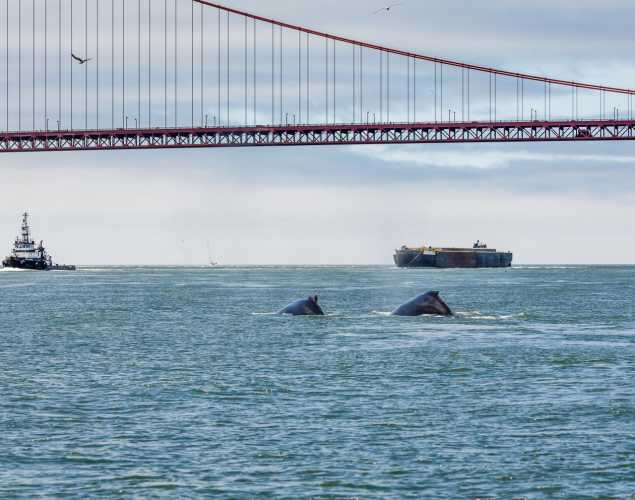
(SAUSALITO, Calif. – February 6, 2026) As gray whales return to San Francisco Bay during their annual migration, The Marine Mammal Center, the world’s largest marine mammal hospital, partnered with the San Francisco Harbor Safety Committee’s Marine Mammal Subcommittee to develop Whale Smart, an education and training program for commercial vessel operators, including high-speed ferry and passenger vessels, to enhance whale safety efforts.
Developed in response to an unprecedented year of gray whale sightings and strandings, Whale Smart builds on coordinated efforts to reduce the risk of vessel strikes and improve safe coexistence between marine traffic and whales in one of the nation’s busiest waterways.
The training program promotes the following best practices in areas of known or recent whale activity through targeted education and communication:
- Understand why gray whales are using San Francisco Bay
- Quickly identify whales and interpret key behaviors to prevent dangerous close encounters
- Navigate safely in high-whale-activity areas using proven, practical operating guidelines
- Share real-time sightings with Vessel Traffic Service to improve awareness and coordination across the bay
“Every action we take in San Francisco Bay matters,” said Kathi George, Director of Cetacean Conservation Biology at The Marine Mammal Center. “Whale Smart gives mariners the information they need to protect whales while maintaining safe and efficient operations, at a time when the species needs it most. Partnerships and collaboration are vital to addressing the complex challenge of whale safety in a heavily trafficked waterway like San Francisco Bay.”
The training program includes a series of short-form training videos designed for practical use by professional mariners.
Why It Matters Now
Last year, 26 whale strandings were reported or responded to in the Bay Area by the Center and partners at the California Academy of Sciences. Of those, 21 were gray whales, with nine classified as suspect or probable vessel strikes.
This comes amid growing concern for the species. NOAA Fisheries’ Southwest Fisheries Science Center released a new population estimate last June for eastern North Pacific gray whales: 12,900 whales, the lowest number since the early 1970s. This follows a recently closed Unusual Mortality Event (UME) that saw the population decline by more than 50 percent. The estimated calf count of 85 is the lowest since record-keeping began in 1994, signaling reproduction levels too low to support population recovery.
Scientists believe changing Arctic conditions — where gray whales feed during the summer — may be forcing the species to adapt to unprecedented environmental changes.
With the first gray whale of 2026 reported unseasonably early inside San Francisco Bay on January 21, 2026, by the Center’s Cetacean Conservation Biology Team, the need to expand protective efforts is critical. Observation data has shown individual gray whales are spending longer periods of time in the bay during their migratory season, and many are actively foraging, heightening the risk of vessel strikes.
Building on Proven Collaboration
Whale Smart builds on protective measures implemented last year in coordination with members of the San Francisco Harbor Safety Committee, including:
- Ferry operators taking proactive steps to avoid whales, such as cutting engines after spotting a gray whale and allowing it to pass safely before resuming service.
- U.S. Coast Guard Vessel Traffic Service (VTS) issues broadcast alerts for all whale sightings, alerting mariners to exercise extreme caution.
- VTS working directly with ferry operators to implement temporary lane changes, particularly east of Angel Island where whale sightings were highest, further reducing the risk of vessel strikes.
The safety committee is the most effective forum we have for balancing navigation safety with the protection of marine wildlife
“The safety committee is the most effective forum we have for balancing navigation safety with the protection of marine wildlife,” said Scott Humphrey, Chair of the San Francisco Harbor Safety Committee. “Whale Smart is an example of a proactive solution to address a complex issue by bringing stakeholders together to solve problems and promote whale and human safety on the water.”
The public can play an important role in protecting whales and helping our experts by reporting sightings through our website or via the WhaleAlert app.
Partners
Golden Gate Ferry, Blue & Gold Fleet, San Francisco Bay Ferry, City Cruises, The Marine Mammal Center, California Academy of Sciences, Benioff Ocean Science Laboratory, California Marine Sanctuary Foundation, San Francisco State University Estuary & Ocean Sciences Center, United States Coast Guard Vessel Traffic Service San Francisco
For more information or to set up an interview on this topic, please contact us at media@tmmc.org.
For breaking news about our whale responses as well as additional press materials, bookmark MarineMammalCenter.org/whale-stranding.
Learn More About Our Work Protecting Whales


Yes, I want to save a life!
You’ll be giving sick and injured animals the best possible care at the Center’s state-of-the-art hospital. With your gift today, you are giving a patient a second chance at life in the wild.
See Our Latest News
{"image":"\/People\/Action\/Response\/cropped-images\/c-common-dolphin93026cuesta-inlet-in-morro-bayphoto-c-the-marine-mammal-center-noaa-mmhsrp-24359-0-399-1270-992-1790883642.jpg","alt":"Stranded dolphin response","title":"Three Common Dolphins Freed from Mudflats in Morro Bay","link_url":"https:\/\/www.marinemammalcenter.org\/news\/three-common-dolphins-freed-from-mudflats-in-morro-bay","label":"News Update","date":"2026-10-02 02:00:00"}
{"image":"\/Animals\/Wild\/Humpback whale\/cropped-images\/a-humpback-whalesf-bay91526photo-by-norely-faz-c-the-marine-mammal-center-noaa-permit-26532-772-1-1270-992-1789760973.png","alt":"Humpback whale Rio","title":"Humpback Whale \"Rio\" Spotted in the Sacramento-San Joaquin Delta","link_url":"https:\/\/www.marinemammalcenter.org\/news\/humpback-whale-rio-spotted-in-the-sacramento-san-joaquin-delta","label":"News Update","date":"2026-09-18 12:10:00"}
Humpback Whale "Rio" Spotted in the Sacramento-San Joaquin Delta
September 18, 2026
Read More{"image":"\/Animals\/Patients\/California sea lions\/2024\/d-california-sea-lionsin-treatment-for-domoic-acidsausalito72624photo-by-giancarlo-rulli-c-the-marine-mammal-center.jpg","alt":"California sea lions","title":"SF GATE: Sick, disoriented sea lions are washing up on California beaches","link_url":"https:\/\/www.marinemammalcenter.org\/news\/sf-gate-sick-disoriented-sea-lions-are-washing-up-on-california-beaches","label":"In the News","date":"2026-09-01 10:39:22"}
SF GATE: Sick, disoriented sea lions are washing up on California beaches
September 1, 2026
Read More{"image":"\/Animals\/Wild\/Sea otter\/cropped-images\/sea-otter-shutterstock-118-0-2496-1950-1604015482.jpg","alt":"sea otter eating clams","title":"What Do Sea Otters Eat? And Other Otter Trivia","link_url":"https:\/\/www.marinemammalcenter.org\/news\/what-do-sea-otters-eat-and-other-otter-trivia","label":"News Update","date":"2026-09-01 02:00:00"}