Take Action: Proposed Federal Regulation Would Weaken Scientific Funding and Integrity
- Species conservation
- Advocacy
At a Glance
The White House Office of Management and Budget (OMB) is seeking to dramatically increase political influence over federal science funding by shifting grant decision-making power from peer-reviewed panels to political appointees.
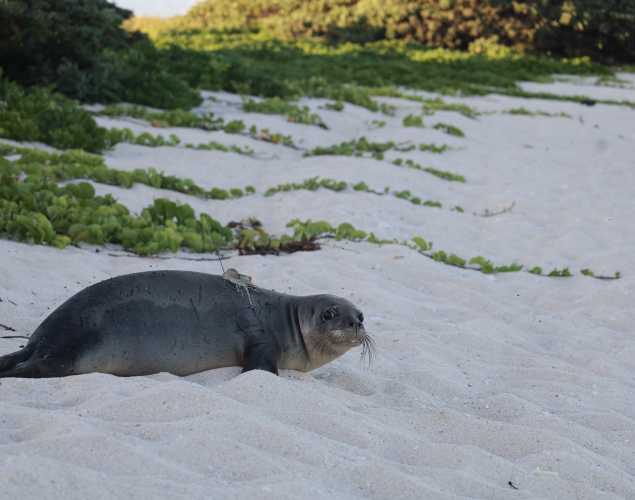
The proposed rule would apply to a vast array of federal agencies, including our critical partners at the National Oceanic and Atmospheric Administration (NOAA). It would also make funding conditional on grantees and projects conforming to the President’s policy priorities, and allow active grants, like those we receive to rescue and care for marine mammals like the endangered Hawaiian monk seal, to be terminated at any time.
The Marine Mammal Center opposes these changes, will be making a formal public comment and has coordinated with professional peers on actions to protect scientific integrity. You can take action and submit a public comment to the Federal Register before the July 13 deadline.
Why This Matters
Our ocean is in trouble, and marine mammals and people alike are facing threats ranging from rising ocean temperatures to emerging diseases. Science and research provide crucial insights into how we can best address these threats and protect our shared ocean and future.
Federal grant funding that currently supports the rescue, rehabilitation and release of a variety of marine mammal species, and the conservation science associated with that work, will now be directed based on decisions by political appointees—who may have no knowledge of the subject—rather than through a peer-review process conducted by scientific experts. Further, these appointees are directed to distribute funding to projects aligned with political ideologies, which will vary based on administration, rather than lean on research or public need to inform their decisions.
The rule also introduces restrictive sanctions on international collaboration and diversity, as well as the option to terminate funding from active grants without a detailed explanation as to why. These changes not only create chaos and uncertainty, plus additional burden on grantees, but also silo conservation efforts that thrive with open channels of communication between experts.
The Proposed Rule: “Regulation for Federal Financial Assistance”
The OMB proposed a rule titled “Regulation for Federal Financial Assistance” on May 29, 2026. The proposed rule is a fundamental change to federal grantmaking that prioritizes politics over scientific integrity.
Led by Chief External Relations Officer Dr. Jeff Boehm, our organization has identified key points to prioritize in your comment, as outlined below.
1. De-prioritization of Scientific Expertise
1. De-prioritization of Scientific Expertise
Relevant sections: 2 CFR § 200.205 (Merit Review), § 200.450 (Issue Advocacy)
The proposed rule would require a “pre-issuance review” to be conducted independently by political appointees of every discretionary grant before it’s awarded. The appointees are explicitly forbidden from deferring to peer reviews for their recommendations and must grant awards that “...demonstrably advance the President’s policy priorities.”
Rather than experts, researchers and a peer-reviewed process driving budgetary decisions, now administrative ideologies would be the prime decision-makers determining which projects are granted funding. Additionally, it seeks to ban “issue advocacy” on “divisive ideologies” such as climate science and public health research. Rather than issuing funding based on merit or need, it will be done based on political alignment.
2. Discouragement of Diversity and Collaboration
2. Discouragement of Diversity and Collaboration
Relevant sections: 2CFR § 200.220 (Covered Foreign Collaborations), § 200.300 (Statutory and national policy requirements)
International collaboration would be increasingly difficult under proposed regulations, which prohibit the use of federal funds for bilateral or multilateral collaboration with “covered foreign countries,” any country designated by statute, Executive Order or other Federal law as a foreign adversary, a country of particular concern, or a country subject to sanctions or restrictions related to national security, defense, or intelligence activities. Federal funds would also be blocked from supporting or promoting Diversity, Equity, and Inclusion (DEI/DEIA) initiatives, even from a separate program or agency within the grantee organization.
These restrictions place unnecessary exclusions on the scientific industry and risk losing the diversity of thought and peer collaboration required to advance science. Our ocean extends beyond our nation’s borders, and so our science must do the same to be effective.

3. Destabilization and Politicization of Funding
3. Destabilization and Politicization of Funding
Relevant sections: 2CFR § 200.340 (Termination and Suspension)
Proposed changes would allow federal agencies to rescind funding for active grants without findings of fraud or noncompliance, and without requiring a detailed explanation. Grants could be terminated for being “inconsistent with program goals or agency priorities,” putting political ideologies once again at the center of decision-making and disrupting the financial ecosystem that allows science to progress most effectively.
Many grants are planned over multi-year periods and include funding for permits, equipment, staff positions and more in order to meet project objectives. If the newly proposed changes take effect, those research projects could be perpetually at risk of ending at any moment based on political beliefs.

You Can Stand Up for Science
Make your voice heard and stand up for scientific integrity. The Federal Register is taking public comments until Monday, July 13, 2026. Submit a public comment to the Federal Register to oppose proposed revisions before the comment period ends.
The more detail and personalization you can add, the more impactful your comment will be. Please note that if you comment, you are doing so as an individual, not on behalf of The Marine Mammal Center.
For additional insight, we recommend reading this opinion piece by former National Institutes of Health Program Official, Elizabeth Ginexi.
Here is a sample message you can adapt for your comment:
“Hi, my name is [Your Name], and I am writing in my personal capacity to oppose the proposed revisions under the 'Regulation for Federal Assistance.' This proposed change would undermine the integrity of the federal grant review processes and federal science agencies’ ability to identify and fund impactful research, such as [OPTIONAL: List examples here such as endangered Hawaiian monk seal conservation, cetacean conservation research, and more].
Federal funding should be directed toward the best science as identified by industry experts, public need and peer-review, not political ideology and authority. These proposed changes would do a disservice to the American public by disrupting the processes that drive science forward worldwide.”
Header photo by Megan Ely © NOAA / NOAA Permit #18786
Yes, I want to save a life!
You’ll be giving sick and injured animals the best possible care at the Center’s state-of-the-art hospital. With your gift today, you are giving a patient a second chance at life in the wild.
See Our Latest News
{"image":"\/Misc\/Graphics\/michelle-oates-detkin-graphic-1.png","alt":"Michelle Oates Detkin","title":"The Marine Mammal Center Welcomes New Board Member Michelle Oates Detkin","link_url":"https:\/\/www.marinemammalcenter.org\/news\/the-marine-mammal-center-welcomes-new-board-member-michelle-oates-detkin","label":"News Update","date":"2026-07-15 10:53:00"}

The Marine Mammal Center Welcomes New Board Member Michelle Oates Detkin
July 15, 2026
Read More{"image":"\/Animals\/Patients\/Steller sea lions\/2025\/sslwestley43photo-by-bill-hunnewell-c-the-marine-mammal-center-1.jpg","alt":"Steller sea lion, Westley.","title":"A Steller Story: Endangered Steller Sea Lion Westley Released in Alaska","link_url":"https:\/\/www.marinemammalcenter.org\/news\/endangered-steller-sea-lion-westley-released-in-alaska","label":"Patient Update","date":"2026-06-18 02:00:00"}

A Steller Story: Endangered Steller Sea Lion Westley Released in Alaska
June 18, 2026
Read More{"image":"\/Animals\/Wild\/Gray whale\/gray-whale-angle-by-josie-slaathaug-c-the-marine-mammal-center.jpg","alt":"A gray whale in San Francisco Bay","title":"The Wall Street Journal: Huge, Hungry Whales Are San Francisco\u2019s Latest Traffic Headache","link_url":"https:\/\/www.marinemammalcenter.org\/news\/wall-street-journal-huge-hungry-whales-are-san-franciscos-latest-traffic-headache","label":"In the News","date":"2026-05-19 15:32:00"}

The Wall Street Journal: Huge, Hungry Whales Are San Francisco’s Latest Traffic Headache
May 19, 2026
Read More{"image":"\/Animals\/Wild\/Other species\/cropped-images\/two-seals-playing-shutterstock-250-0-3211-2510-1602631793.jpg","alt":"two seals playing on a beach","title":"Meaningful Father\u2019s Day Gifts for Ocean Lovers","link_url":"https:\/\/www.marinemammalcenter.org\/news\/eco-friendly-fathers-day-gifts-that-give-back","label":"News Update","date":"2026-05-15 12:37:00"}